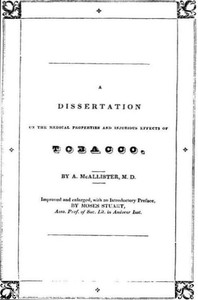
A Dissertation on the Medical Properties and Injurious Effects of the Habitual Use of Tobacco Book Summary
Introduction
This summary explores Dr. John Hill's 1784 work, "A Dissertation on the Medical Properties and Injurious Effects of the Habitual Use of Tobacco." While not the first to critique tobacco, Hill's methodical approach and specific medical arguments were influential in the ongoing discourse about its dangers during the 18th century.
What is this book about?
"A Dissertation on the Medical Properties and Injurious Effects of the Habitual Use of Tobacco" is a 1784 medical treatise by Dr. John Hill. It systematically argues against the use of tobacco, presenting it as a harmful substance rather than a pleasant indulgence. Hill details the specific ailments and negative health consequences he attributes to regular tobacco consumption, drawing on contemporary medical knowledge. He addresses common counter-arguments used by proponents of tobacco, such as its perceived medicinal properties or its role in social rituals. While acknowledging addiction as a challenge, the core of the dissertation is its detailed critique of tobacco's physical and physiological impact on the human body.
Key Lessons
The book's core lesson is the systematic documentation of tobacco's negative health impacts, predating many modern concerns.
Firstly, Hill meticulously lists the physical harm tobacco causes. He describes how it can lead to chronic conditions like coughing, hoarseness, and throat irritation, as well as more systemic issues like indigestion, sluggishness, and even contributing factors for more serious diseases. He emphasizes that while tobacco might provide temporary relief or stimulation, these benefits are vastly outweighed by the long-term damage. For example, he might link chronic smoking habits to the weakening of the lungs or the digestive system, arguing these effects were observable and serious.
Secondly, Hill tackles the defense of tobacco, acknowledging its historical use in medicine or as a social lubricant, but systematically dismantling these justifications. He points out that the supposed medicinal benefits were often overstated or based on flawed observations, and the social aspects, while valid, do not negate the inherent health risks. This balanced approach, addressing both sides while firmly advocating the medical dangers, was innovative for its time.
Thirdly, the book implicitly highlights the difficulty of breaking the habit. While Hill argues strongly against starting or continuing the use of tobacco, he also recognizes the addiction aspect, suggesting that the temporary pleasures or perceived benefits make cessation difficult. This nuanced understanding of addiction as a barrier to health advice adds depth to his critique beyond simply stating 'tobacco is bad'.
Is this book fit for me?
This book is particularly suitable for readers interested in:
- The history of medicine and public health.
- Understanding how arguments against tobacco were formulated centuries ago.
- The evolution of scientific understanding regarding tobacco's dangers.
- Seeing the precursors to modern health warnings and research.
- The social and cultural history of smoking.
- Exploring how tobacco use became embedded in societal practices.
- Medical professionals or students studying the historical context of health interventions.
- Those curious about the debate surrounding potentially harmful substances.
Does it still matter today?
Yes, absolutely. While Dr. Hill's specific arguments and medical understanding are dated, the fundamental critique of tobacco's harm remains profoundly relevant. The book serves as a fascinating historical marker, showing how concerns about tobacco were already being articulated with a medical framework long before the overwhelming scientific consensus of the 20th and 21st centuries. It provides valuable context for understanding the long battle against tobacco use and the nature of health advocacy. The core lessons about specific health risks (respiratory issues, digestive problems) caused by tobacco use were established long ago and continue to be validated by modern science.
However, while the book is historically significant, its arguments are not the most comprehensive or up-to-date resources on the topic available today.
**Suggest Book:** "Tobacco Tactics: The Global Response to a Health Crisis" by Michael Siegel
Why? Michael Siegel's book provides a much more detailed and contemporary look at the tobacco epidemic, the history of tobacco control efforts, the development of public policy (like taxation and advertising bans), and the scientific evidence linking tobacco to countless diseases. It builds upon the foundation laid by earlier works like Hill's but offers a broader, more nuanced, and evidence-based perspective on the global tobacco problem.
| Reading on Gutenburg | Free reading |
| Get Paperback Version on Amazon | Buy a book |
| Suggest Book : Tobacco Tactics: The Global Response to a Health Crisis Book | Get on Amazon |
Conclusion
"A Dissertation on the Medical Properties and Injurious Effects of the Habitual Use of Tobacco" is a significant piece of 18th-century medical literature that offered a forceful critique of tobacco use. While its specific arguments are now supplemented by vast amounts of scientific data, its value lies in providing a historical perspective on the understanding and dangers of tobacco. It demonstrates that the concerns Hill raised were foundational to the eventual recognition of tobacco as a major public health issue. For readers interested in the history of health, science, or public policy, this book offers valuable insights, though more recent scholarship provides a more complete picture of the tobacco crisis.