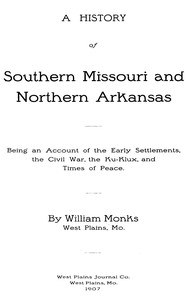
A History of Southern Missouri and Northern Arkansas Being an Account of the Early Settlements, the Civil War, the Ku-Klux, and Times of Peace Book Summary
Published in 1894 by Goodspeed Publishing Company, A History of Southern Missouri and Northern Arkansas is a fascinating, though undeniably biased, look at the development of the Ozarks region. It's a classic example of a county and biographical history, common in the late 19th century, aiming to attract settlers and investment by highlighting the area’s potential and celebrating its leading citizens. Be aware that this work reflects the perspectives and prejudices of its time, particularly regarding race and the Civil War.
This book meticulously details the history of numerous counties in Southern Missouri and Northern Arkansas, covering their geological formation, early Native American inhabitants, and the arrival of European and American settlers. It focuses heavily on the period leading up to, during, and immediately following the Civil War, detailing local involvement, battles, and the subsequent rise of Reconstruction-era challenges, including the Ku Klux Klan. Beyond the political and military history, it’s packed with biographical sketches of prominent families and individuals who shaped the region, detailing their contributions to business, politics, and community life. It's essentially a collection of local narratives woven into a broader regional history.
The enduring impact of the Civil War on the Ozarks: The book vividly demonstrates how deeply the Civil War fractured communities in Southern Missouri and Northern Arkansas. Unlike regions with clear allegiances, the Ozarks saw significant internal division, leading to guerilla warfare and brutal neighbor-against-neighbor conflicts. The author frequently portrays the motivations of Confederate sympathizers, often framing their actions as defensive or justified, even when involving violence. Understanding this context is crucial for appreciating the long-lasting social and economic scars left by the war, and why reconciliation was so difficult and drawn out.
The complex relationship between settlers and Native Americans: While the narrative largely focuses on the arrival and success of European-American settlers, it also acknowledges the presence and displacement of various Native American tribes. However, this acknowledgment is often framed through a lens of manifest destiny, portraying Native Americans as obstacles to progress rather than as people with legitimate claims to the land. The book details treaties, forced removals, and conflicts, offering a glimpse into the injustices inflicted upon Indigenous populations, even if it doesn't explicitly condemn them. It’s a reminder that the history of settlement is always intertwined with the history of dispossession.
The power of local narratives in shaping regional identity: A History of Southern Missouri and Northern Arkansas isn't a top-down historical account; it's built from the ground up through hundreds of biographical sketches and county-level histories. This approach reveals the importance of individual agency and local events in shaping the broader regional identity. The book emphasizes the self-reliance, resilience, and entrepreneurial spirit of the early settlers, constructing a narrative of rugged individualism that became a defining characteristic of the Ozarks. This highlights how history is often remembered and retold through the stories of those who lived it.
The challenges of Reconstruction and the rise of white supremacist groups: The book provides a detailed, though again biased, account of the Reconstruction era in the region. It describes the political turmoil, the attempts to enfranchise African Americans, and the backlash from white southerners. The author’s portrayal of the Ku Klux Klan is particularly revealing. While acknowledging their violence and intimidation, he often presents them as a response to perceived injustices and a means of restoring “order” to society. This demonstrates the need to critically examine historical sources and understand the perspectives that shaped them, especially when dealing with sensitive topics like racial violence and oppression.
This book is ideal for readers who:
- Are interested in the history of the Ozarks region (Southern Missouri and Northern Arkansas).
- Enjoy detailed county and family histories.
- Want a primary source perspective on the Civil War and Reconstruction in a specific geographic area.
- Are prepared to critically analyze a historical text with inherent biases.
- Are researching genealogy in the region – the biographical sketches are invaluable.
Yes, this book matters today, but primarily as a historical artifact and a window into the past. It's crucial for understanding how the region developed and the lingering effects of its history, particularly concerning racial dynamics and political divisions. However, its biases require careful consideration. To gain a more balanced and nuanced understanding, it’s essential to supplement this account with contemporary scholarship.
Therefore, I suggest reading:
| Reading on Gutenburg | Free reading |
| Get Paperback Version on Amazon | Buy a book |
| Suggest Book : Reconstruction: America's Unfinished Revolution, 1863-1877 Book | Get on Amazon |
A History of Southern Missouri and Northern Arkansas is a valuable, albeit flawed, resource for anyone interested in the history of this unique region. Its detailed accounts of local events and prominent families offer a rich tapestry of the past, but readers must approach it with a critical eye, recognizing the biases inherent in its late 19th-century perspective. It serves as a potent reminder that history is always a matter of interpretation and that multiple narratives are necessary to achieve a complete understanding.