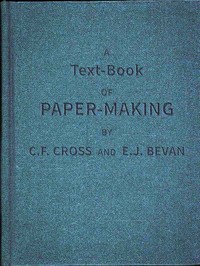
A Text-book of Paper-making Book Summary
The book provides a detailed blueprint of the paper manufacturing process, emphasizing its complexity and the interplay of various factors:
Firstly, it breaks down the process into distinct stages: preparing the raw material (wood chips), pulping (mechanical or chemical), cleaning and bleaching the pulp, forming the paper web, pressing to remove water and shape the sheet, drying with heated cylinders, calendering for surface smoothness, and finally cutting and packaging. Each stage is described with technical precision, explaining the machinery, chemical treatments, and physical principles involved.
Secondly, the book highlights the importance of chemical processes. It details the chemistry of pulping (how wood fibers are separated), bleaching (removing lignin and other impurities), and sizing (modifying the paper surface properties). Understanding the chemical composition and reactions is presented as fundamental to controlling quality and efficiency.
Thirdly, it underscores the role of engineering and mechanics. Descriptions of the massive paper machine, with its forming wire, vacuum boxes, presses, and drying cylinders, show how mechanical forces and precise engineering are crucial for converting pulp into a uniform sheet. The book explains concepts like dewatering, tension control, and heat transfer within this complex system.
Finally, it implicitly teaches about quality control and efficiency. While not explicitly modern management, the detailed descriptions suggest an awareness of the need for consistency in raw materials, process control, and the careful monitoring of each stage to produce paper meeting specific standards. It's a technical manual focused on mastering the physical and chemical transformations necessary for paper production.
This book is ideal for specific readers:
- Those with a strong interest in the history of industry and technology, specifically the evolution of papermaking.
- Students or professionals studying chemical engineering, mechanical engineering, or forestry, seeking detailed knowledge of industrial processes.
- Individuals involved in historical research related to manufacturing, materials science, or the pulp and paper industry.
- Anyone needing a comprehensive, historically accurate reference on traditional papermaking techniques, particularly from wood pulp.
However, its dense technical language from the early 1900s and focus on specific historical machinery and processes might be challenging for casual readers or those seeking modern perspectives on sustainable paper production.
| Reading on Gutenburg | Free reading |
| Get Paperback Version on Amazon | Buy a book |
| Suggest Book : Pulp and Paper: Chemistry and Technology Book | Get on Amazon |
In conclusion, "A Text-book of Paper-making" provides a thorough, albeit dated, exploration of the intricate world of paper production. It serves as a crucial historical document and a foundational text for understanding the chemical, mechanical, and engineering principles that underpin the industry. While superseded by more modern texts covering new technologies and sustainability issues, its detailed description of the fundamental processes remains a valuable resource for historians, engineers, and anyone seeking a deep dive into the industrial past of papermaking.