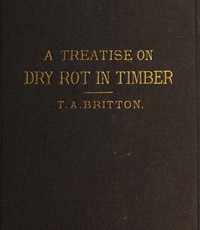
A treatise on the origin, progress, prevention, and cure of dry rot in timber Book Summary
Introduction
This treatise dives deep into the persistent problem of dry rot, a specific type of wood decay that has plagued construction and preservation efforts for centuries. It promises not just a description but a practical guide, outlining its causes, how it progresses, and crucially, how to prevent and cure it. Authored by William Henry West, a practical man with a scientific bent, this 1889 work offers detailed observations and practical advice, making it a valuable historical resource for those dealing with aging wooden structures.
What is this book about?
'A Treatise on the Origin, Progress, Prevention, and Cure of Dry Rot in Timber' is a comprehensive exploration of the fungal decay known as dry rot. It begins by defining the condition, distinguishing it from other types of wood decay. The core of the work meticulously details the origins of dry rot, primarily linking it to the presence of moisture and specific fungal species. It then explains how the decay physically progresses through wood, detailing the visible signs and structural damage. A significant portion is dedicated to practical prevention strategies, such as proper material selection, ventilation, and moisture control. Finally, the book outlines various methods for treating and curing existing infestations, offering practical solutions for restoration.
Key Lessons
The book fundamentally emphasizes that moisture is the primary catalyst for dry rot. West argues convincingly that without adequate moisture, the fungus cannot establish itself or spread. This isn't just about surface dampness; it's about the wood itself being damp enough for the fungus. For example, a wooden beam in a poorly ventilated attic, even if externally dry, might internally harbor moisture and become susceptible. The lesson here is critical: controlling moisture levels is the most effective preventative measure.
Secondly, the book stresses the importance of ventilation. Proper air circulation is presented as a vital defense against the buildup of moisture and the proliferation of decay organisms. Stagnant air traps moisture, creating ideal conditions. West advocates for designing and maintaining structures with good airflow, especially in areas prone to humidity or dampness. Think of a well-ventilated crawl space versus a sealed one; the former is significantly less likely to suffer from rot.
Thirdly, material selection and preparation are highlighted. While not advocating for unnatural materials, West discusses the inherent decay resistance of certain woods (like teak) and the importance of treating or seasoning timber before use. He also touches upon the dangers of using unseasoned or green wood, which contains higher moisture levels and is more vulnerable. This lesson encourages a thoughtful approach to sourcing and preparing wood for construction or preservation.
Fourthly, the book provides practical insights into detection and treatment. It describes symptoms like surface checking, darkening, and the 'concrete smell' of decay, teaching the reader how to spot problems early. Regarding cures, it outlines methods like removing affected wood, applying antifungal treatments (often physical barriers like creosote or bordeaux mixture at the time), and ensuring the underlying moisture problem is fixed. The lesson is that cure requires a thorough understanding of the problem and often involves more than just surface treatment.
Is this book fit for me?
- Yes, if you are involved in the restoration or preservation of old wooden structures (houses, ships, furniture).
- If you are a student of mycology, forestry, or building science interested in historical perspectives on decay.
- If you are a craftsman or builder wanting to understand the fundamental principles of wood preservation.
- If you are researching the history of construction materials and techniques.
- If you are curious about the science behind fungal decay from a 19th-century perspective.
Does it still matter today?
Absolutely. The core principles outlined in this book regarding the necessity of moisture control, the dangers of poor ventilation, and the importance of material integrity are still fundamental to preventing wood decay today. Dry rot remains a significant problem in aging buildings, historical monuments, and wooden structures worldwide. The book provides invaluable historical context and practical observations that can inform modern practices. However, while the underlying science is sound, the specific chemical treatments and detailed methods might be superseded by modern, often more environmentally conscious, approaches.
| Reading on Gutenburg | Free reading |
| Get Paperback Version on Amazon | Buy a book |
| Suggest Book : The Book and Care of Wood Book | Get on Amazon |
Conclusion
West's treatise is a significant historical document. It offers a thorough, practical, and scientifically grounded analysis of dry rot that, despite its age, retains considerable relevance. While modern materials and treatments have evolved, the fundamental understanding of moisture as the primary enemy of wood decay remains unchanged. This book provides a foundational perspective for anyone serious about the long-term preservation and understanding of wooden structures. It complements contemporary guides by grounding the reader in the persistent nature of the problem and the timeless importance of prevention.