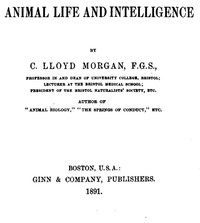
Animal Life and Intelligence Book Summary
Introduction to Animal Life and Intelligence
William James' 1905 work, "Animal Life and Intelligence," originally published in the Popular Science Monthly, offers a fascinating exploration into the cognitive capabilities of animals. While not a comprehensive treatise on animal behavior, this essay provides James, a leading figure in psychology, reflections on the nature of animal consciousness, intelligence, and their place in the animal kingdom. It delves into questions about whether animals think, feel, and possess forms of intelligence distinct from humans. James examines evidence from observation, experimentation, and philosophical considerations to challenge simplistic views of animals as mere reflex machines and to suggest a more complex inner life.
What is This Book About?
"Animal Life and Intelligence" is an essay by William James, primarily focused on the consciousness and mental processes of animals. James questions the common assumption that human thought is fundamentally different from or superior to that of animals. He explores the idea that intelligence might be a continuum, examining evidence from animal behavior, learning, memory, and even social interactions. The essay is less about cataloging animal behaviors and more about philosophical and psychological analysis, attempting to understand the nature of animal experience and its relation to human cognition. James considers experiments, observations of instinct and learning, and the physiological basis of consciousness to build his arguments.
Key Lessons
This essay, though concise, offers several profound insights:
1. The Continuum of Consciousness: James proposes that consciousness might be a continuous spectrum, not a sharply divided category between humans and other animals. He suggests that the difference lies in degree rather than kind, implying that many animals possess rudimentary forms of awareness and thought. He uses examples like the instinctive behavior of animals and their capacity for learning through experience to support this idea.
2. Intelligence as Problem-Solving: James defines intelligence partly through an animal's ability to solve problems and adapt to its environment. He discusses observations of animals finding food, navigating complex terrains, and learning tricks, suggesting these actions require some form of cognitive processing, even if different from human abstract thought. He references experiments where animals learn associations or exhibit persistence in achieving goals.
3. Challenging Anthropomorphism (to a degree): While acknowledging that we project human traits onto animals (anthropomorphism), James argues that this projection shouldn't entirely blind us to potential animal cognition. He encourages careful observation to distinguish between behaviors that might be driven by instinct or simple conditioning versus those that suggest genuine understanding or intentionality.
4. The Mystery of Animal Psychology: James concludes that while we can observe animal behavior and make inferences, directly accessing the subjective experience (qualia) of animals remains a significant challenge. The inner life of an animal might be fundamentally unlike our own, and our language and conceptual frameworks are inadequate to fully capture it. He uses analogies, perhaps similar to trying to understand the visual experience of a bat using echolocation without having the same visual system.
Is This Book Fit For Me?
This essay is ideal if you:
- Are interested in the philosophy of mind or psychology and want a classic perspective on animal cognition.
- Want to understand the historical context of debates about animal intelligence.
- Enjoy concise, thought-provoking essays that challenge common assumptions.
- Are curious about the nature of consciousness and how it might vary across species.
- Have some basic familiarity with psychological concepts or are willing to engage with philosophical arguments.
It might not be the best fit if you're looking for a comprehensive scientific study of animal cognition with extensive research or detailed behavioral analysis.
Does It Still Matter Today?
Yes, absolutely. William James' essay remains highly relevant. It predates the major cognitive revolution and the explosion of research in animal cognition and comparative psychology, but its core questions persist:
- Does consciousness exist beyond humans?
- How intelligent are animals, and what forms does intelligence take?
- What are the ethical implications of recognizing animal cognition and potentially their suffering?
- How do we study and understand minds that are structurally different from our own?
The debates James initiated continue in modern science and philosophy, informing fields like ethology, cognitive science, neuroscience, and animal ethics.
Suggested Next Book: "Mindspace: The Science of Animal Thought" by Evan Westerman
"Mindspace" offers a much more recent, evidence-based exploration of animal cognition, drawing on contemporary research in neuroscience, ethology, and cognitive science. It addresses many of the same fundamental questions James posed using modern methods and findings, providing a stark contrast to James' philosophical approach with actual scientific data and theories about animal thought processes, memory, and social intelligence. This book builds upon the legacy of James' pioneering work by grounding the discussion firmly in current scientific understanding.
| Reading on Gutenburg | Free reading |
| Get Paperback Version on Amazon | Buy a book |
| Suggest Book : Mindspace: The Science of Animal Thought Book | Get on Amazon |
Conclusion
"Animal Life and Intelligence" by William James is a concise but powerful essay that fundamentally challenged the anthropocentric view of animal minds prevalent in its time. It proposed a continuum of consciousness and urged careful consideration of animal behavior as evidence of intelligence. While written over a century ago, its core questions about the nature of animal cognition, the definition of intelligence, and the limits of our understanding persist, making it a valuable read for anyone interested in the philosophy of mind, psychology, or the ethics of our treatment of animals. For a more modern perspective grounded in scientific research, "Mindspace: The Science of Animal Thought" is an excellent follow-up.