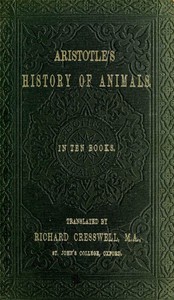
Aristotle's History of Animals In Ten Books Book Summary
Aristotle's Enduring Legacy in Zoology
Aristotle's History of Animals, spanning ten books, stands as one of the foundational texts in the history of biology. Written in the 4th century BCE, it represents a monumental effort to systematically study and classify the animal kingdom through direct observation and logical deduction. Before modern tools and genetics, Aristotle compiled vast knowledge about the anatomy, physiology, behavior, reproduction, and classification of countless species, making it an invaluable window into ancient scientific thought and practice.
Scope and Method
The work is an encyclopedia of animal life, covering everything from terrestrial and aquatic animals to plants (to some extent) and their parts. Aristotle and his student Theophrastus meticulously described the habitats, appearances, habits, reproductive strategies, senses, and internal structures of animals they could observe directly or through reports. They explored questions about embryology, the nature of blood, respiration, movement, and sensory perception. A central theme is classification – attempting to organize the vast diversity of life into natural groups based on shared characteristics, laying early groundwork for biological taxonomy.
Key Insights from Aristotle's Work
While today we might find some of Aristotle's classifications outdated (like his distinction between 'higher' and 'lower' animals based on perceived intelligence), the Scientific Observation and Description methodology he championed was revolutionary. He stressed the importance of firsthand observation (or detailed accounts) before drawing conclusions. For instance, his detailed descriptions of animal anatomy, like comparing the skeletons of different vertebrates to understand their functions, demonstrate an early form of empirical science, though lacking the experimental rigor of modern biology.
Classification Attempts are another major theme. Aristotle's system, while simplistic by modern standards, shows an attempt to impose order on complexity. He classified animals based on their habitats (aquatic, terrestrial, aerial) and then further subdivided them based on body parts, like the presence of feathers versus scales. This effort, though flawed, highlights the human drive to categorize and understand the natural world systematically.
Comparative Anatomy and Early Hypotheses are evident throughout. Aristotle speculated on homologous structures (like comparing limbs across different animals) and attempted to explain evolutionary concepts like 'recapitulation,' where he thought an embryo's development briefly mirrored its evolutionary history. He also made significant strides in understanding embryology, describing development in birds and mammals (though his mechanisms were incorrect). His work on animal senses, suggesting different senses correspond to different parts of the brain, shows an insightful, if not always accurate, biological inquiry.
Integration of Empirical and Logical Reasoning is central. Aristotle didn't just observe; he used logic and analogy to connect observations. He combined empirical data with philosophical reasoning to formulate theories about animal nature, habits, and place in the cosmos. This blend of observation and logic was characteristic of his approach to all fields of inquiry.
Who Would Benefit?
This book is primarily of interest to those studying the history of science, particularly the history of biology and philosophy. Students and scholars in classics or ancient Greek literature might also find it valuable for understanding primary sources. Anyone interested in the origins of biological classification or the scientific method's evolution would benefit from reading it. It offers fascinating insights into how ancient thinkers approached the natural world, providing a stark contrast to modern scientific practices. However, its dense, often verbose language and lack of modern scientific context might make it challenging for casual readers or those solely interested in contemporary biology.
Enduring Relevance
Yes, Aristotle's History of Animals still matters today. It is a crucial primary source that allows us to understand the intellectual landscape of ancient Greece and the birth of scientific thought. It provides invaluable historical context for the development of biological taxonomy and the scientific method. Reading it helps us appreciate the journey of biological understanding from observation-based classification to hypothesis-driven experimentation and molecular genetics. While the specific biological knowledge is outdated, the work remains significant for historians of science and philosophy.
| Reading on Gutenburg | Free reading |
| Get Paperback Version on Amazon | Buy a book |
| Suggest Book : A Short History of Biology: From Aristotle to DNA Book | Get on Amazon |
In Summary
Aristotle's History of Animals is a landmark work, representing one of the first systematic attempts to document, classify, and understand the animal kingdom through observation and logic. Despite its limitations in biological accuracy and methodology by modern standards, its historical significance is immense. It offers a fascinating glimpse into the mind of one of history's greatest thinkers and the foundations of biological science. While perhaps not essential reading for a modern biology student, it is indispensable for understanding the history of science and the roots of biological classification. For further exploration of biological history, consider "A Short History of Biology: From Aristotle to DNA".