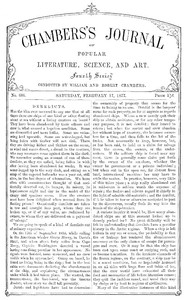
Chambers's Journal of Popular Literature, Science, and Art, No. 686 February 17, 1877 Book Summary
Chambers's Journal offers valuable lessons about knowledge dissemination and the public sphere during a transformative period. Firstly, its power lies in its successful integration of diverse disciplines. By connecting literature, science, and art, it demonstrated how understanding one field could illuminate another. For instance, an article on landscape painting might naturally lead into geological explanations of rock formations, or a discussion of social reform literature could touch upon contemporary political science. This holistic approach encouraged readers to see the world as interconnected, fostering a more syncretic understanding.
Secondly, the journal exemplifies the art of accessible communication. Its editors and contributors were masterful at translating complex ideas – from Darwinian evolution to architectural principles – into engaging prose for a non-specialist audience. They avoided jargon, used vivid descriptions, and presented information in a narrative style that held the reader's interest. This skill remains relevant today, reminding us of the importance of clear communication across all fields.
Thirdly, it highlights the democratization of knowledge. While not entirely egalitarian (access was still limited by cost and education), it consciously aimed to elevate the intellectual level of its readers, who were expected to be the middle and upper classes, including women. It presented information previously available only to the elite in expensive books or learned journals, making it more widely accessible and fostering a burgeoning public culture based on shared knowledge. Finally, the journal reflects the dynamic spirit of the Victorian age – an era of rapid industrialization, scientific breakthroughs, artistic movements, and social change. It served as a mirror to these developments, keeping its readers informed about the latest ideas and events, thus functioning as both an educational tool and a cultural document.
This book is ideal if you are interested in:
- The history of Victorian publishing, periodicals, and mass media.
- Understanding the cultural and intellectual landscape of 19th-century Britain.
- Gaining insight into how knowledge was popularized and consumed before the modern age of information.
- Appreciating the evolution of science communication and its presentation to the public.
- Exploring the interplay between literature, science, and art during a period of significant change.
- Enjoying well-written, engaging articles from a historical perspective.
It might be less suitable if your primary goal is to find contemporary scientific information or if you are looking for purely fictional entertainment, though its articles on literature certainly fulfill that need to some extent.
Yes, Chambers's Journal absolutely still matters today, primarily as a historical document and a study in the evolution of knowledge dissemination. Its significance lies in its demonstration of how a resourceful group could create a comprehensive and engaging educational tool in the pre-digital age. It provides invaluable context for understanding the intellectual ferment of the Victorian era and the development of fields like anthropology, archaeology, and popular science writing.
While its specific content is outdated, its approach to integrating subjects and making complex ideas accessible remains highly relevant. It serves as a benchmark for effective popularization of knowledge, a practice that continues (though perhaps differently) in science blogs, magazines, and public lectures today. However, its format as a physical periodical and its specific cultural context might make it less immediately engaging for all modern readers.
Given its historical nature, I suggest reading a more recent work that offers a critical analysis of periodicals like Chambers's Journal and its contemporaries within the broader context of Victorian culture and print media. The Victorian Periodical: An Oxford Guide provides a comprehensive overview and critical framework for understanding publications like this one.
| Reading on Gutenburg | Free reading |
| Get Paperback Version on Amazon | Buy a book |
| Suggest Book : The Victorian Periodical: An Oxford Guide Book | Get on Amazon |