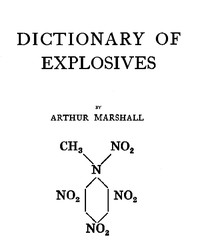
Dictionary of Explosives Book Summary
Dictionary of Explosives
A comprehensive reference guide detailing the properties, composition, and uses of various explosive materials.
Book Overview
Published in 1914, Dictionary of Explosives serves as a technical reference work. It systematically catalogues a wide range of explosive substances, covering their chemical makeup, physical properties, methods of initiation, and practical applications. The book aims to provide engineers, military personnel, miners, and scientists with a clear, factual compendium of information essential for understanding and handling explosives safely and effectively. It functions much like a dictionary or encyclopedia, defining terms and describing specific compounds and mixtures prevalent during its time.
Key Concepts from the Dictionary
At its core, this book is a repository of technical knowledge organized for clarity and reference.
1. Systematic Classification: The book goes beyond simple naming. It explains how explosives are classified based on their chemical composition (e.g., nitrate-based like ammonium nitrate, nitride-based like nitroglycerin), physical state (solid, liquid, gas), and mode of action (high explosives, propellants, blasting agents). For example, it distinguishes between stable explosives like dynamite (a stabilized form of nitroglycerin) and more sensitive ones like TNT or RDX, highlighting the critical difference between power and sensitivity.
2. Chemical Fundamentals: Understanding the chemistry is paramount. The book details the chemical reactions involved in detonation – the rapid oxidation that releases energy. It explains the role of oxygen balance, where the explosive provides just the right amount of oxygen for complete combustion of its carbon and hydrogen, maximizing power and minimizing toxic byproducts. This principle was crucial for developing more efficient explosives. For instance, formulas are given to calculate oxygen balance for mixtures like ammonium nitrate and fuel oil (ANFO).
3. Properties and Performance: For each explosive, detailed data is provided: density, detonation velocity (how fast the shock wave travels), power (measured by how much material it displaces or the size of crater it forms), brisance (shattering power), and most importantly, sensitivity (how easily it detonates – shock, heat, friction). This information was vital for selecting the appropriate explosive for a specific task, whether it was mining rock, destroying enemy structures, or safely demolishing a building.
4. Initiation and Handling: The book covers the essentials of detonation initiation, discussing different types of detonators and the principles of fuze composition. It emphasizes the critical nature of safety – how to handle, transport, and store these dangerous materials correctly to prevent accidental detonation. This included information on stability over time and inert ingredients.
In essence, it's a foundational text that breaks down the complex world of explosives into understandable, searchable facts, crucial for anyone working with these powerful materials.
Who Would Find This Book Useful?
This book is primarily intended for:
- Historians studying the technology, military tactics, or industrial practices of the early 20th century.
- Students of chemistry, chemical engineering, mining engineering, or military science seeking foundational knowledge on explosives.
- Researchers in fields like forensic science, archaeology (for analyzing residues), or ordnance disposal who need historical context and detailed properties of older explosives.
- Collectors of technical reference books or those interested in the history of science and technology.
- Individuals needing a primary source reference for specific details about pre-20th-century explosives (though modern safety standards and newer compounds might not be covered).
Enduring Relevance?
While the specific formulations and applications covered in Dictionary of Explosives (1914) might be superseded by modern developments, the fundamental principles it lays out remain incredibly relevant today.
The concepts of chemical composition, detonation mechanics, properties like velocity and power, sensitivity, and safety handling are the bedrock of modern explosive science and engineering. Understanding oxygen balance, for example, is still critical in designing efficient explosives and propellants. The book provides a valuable historical baseline, showing the evolution of explosive technology from early, often dangerous formulations to more controlled and powerful modern ones. It helps us understand the scientific knowledge that paved the way for today's sophisticated materials and safety protocols. For example, knowing the properties of older TNT allows better understanding of modern HMX or RDX.
| Reading on Gutenburg | Free reading |
| Get Paperback Version on Amazon | Buy a book |
| Suggest Book : Modern Explosives Chemistry Book | Get on Amazon |
Conclusion
While Dictionary of Explosives is a product of its time, its value lies in its systematic approach and detailed information on the fundamental science and practical aspects of explosives during a crucial period of development. It remains an important historical and educational resource, offering insights into the building blocks of modern explosive technology. For those seeking contemporary understanding, further reading on modern explosives chemistry and safety would be beneficial.