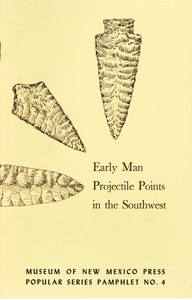
Early Man Projectile Points in the Southwest Book Summary
Introduction
Artifacts scattered across landscapes hold silent stories of the people who once lived there. Projectile points—implements for hunting—serve as particularly compelling narratives. "Early Man Projectile Points in the Southwest," published in 1934 by the University of New Mexico Bulletin, delves into these artifacts, primarily from the American Southwest. Authored by archaeologists Paul R. Martin and Fred W. Hodge, the book meticulously catalogs and analyzes these points, using them to reconstruct the lives, movements, and technological evolution of the region's earliest inhabitants and subsequent Native American groups.
What is this book about?
This work is fundamentally an archaeological typology and analysis of projectile points. It systematically classifies hundreds of arrowheads, spear points, and darts found in New Mexico and adjacent areas. The authors establish a detailed classification system based on the points' material composition, shape, size, and flaking technique. By arranging these points chronologically and associating them with specific archaeological site types and cultural phases, Martin and Hodge aim to trace the development of Native American technology, subsistence strategies (primarily hunting), and possible cultural influences over millennia in the Southwest. The book is a foundational piece in understanding the prehistory of the region through its material culture.
Key Lessons
The book illuminates how seemingly simple objects like arrowheads can be powerful tools for understanding deep time. One major lesson is the concept of **Technological Change and Adaptation**: The detailed typology shows distinct styles appearing and evolving over time. For example, the book discusses the Folsom tradition, characterized by highly fluted projectile points associated with bison hunting, contrasting it with earlier, simpler Clovis points and later, more varied styles. This demonstrates how groups adapted their tool-making to environmental changes, prey availability, and cultural innovations. Another lesson is the ability to **Track Cultural Development**: By mapping point types onto site stratigraphy and artifact distributions, the authors argue for a sequence of cultural occupations. The book shows how specific point types are linked to particular lifestyle adaptations, like the shift towards smaller projectile points potentially indicating a change to hunting different animals or utilizing more diverse environments. Furthermore, the meticulous **Classification and Description** itself is a key takeaway. The book emphasizes the importance of careful documentation, including material, size, weight, and retouch, as the basis for any meaningful interpretation of prehistoric behavior. It demonstrates that classification is not arbitrary but a scientific method to identify patterns and changes in the archaeological record. Finally, the book subtly addresses the **Use of Material Culture as Proxy Data**: Since direct historical records for the earliest inhabitants don't exist, projectile points become the primary evidence for their existence, technological capabilities, and subsistence practices, highlighting the role of artifacts in reconstructing the past when other records are absent.
Is this book fit for me?
This book is ideal for:
- Archaeology Enthusiasts: Readers interested in prehistoric America, particularly the Southwest, will appreciate the detailed typology and the insights into early human presence and technological evolution.
- Students of Archaeology: It serves as a classic example of early archaeological methodology, focusing on artifact typology and its use in cultural chronology, providing a historical perspective on how archaeology was practiced in the early 20th century.
- Those interested in Southwest History: It offers a tangible link to the ancient inhabitants of the region, using everyday tools to piece together their lives and adaptations.
- Patrons of Museums: Understanding the classification system helps in appreciating the artifacts displayed in museums.
Does it still matter today?
Yes, absolutely. "Early Man Projectile Points in the Southwest" remains relevant for several reasons. First, the fundamental principles of using projectile point typology to understand technological change and chronology laid out in this book form the basis for much of modern archaeological analysis in the Southwest. The classification systems, while detailed and specific to their context, introduced concepts still used today. Second, it provides crucial baseline data and one of the earliest systematic studies of the human occupation of the Southwest, which is invaluable for ongoing research. The book helps anchor modern findings within a long sequence of human adaptation. Third, it highlights the enduring power of artifacts to tell stories of human ingenuity and adaptation across vast timescales, connecting us to our deep past. The study of material culture continues to be a core method in archaeology, and this foundational work demonstrates its potential.
| Reading on Gutenburg | Free reading |
| Get Paperback Version on Amazon | Buy a book |
| Suggest Book : Prehistory of the Southwest: An Ecological Approach to Prehistoric Settlement Book | Get on Amazon |
Conclusion
"Early Man Projectile Points in the Southwest" by Martin and Hodge is a specialized, yet historically significant, contribution to archaeological literature. It provides invaluable insights into the classification and significance of these vital artifacts, using them as keys to unlock the prehistory of the American Southwest. While perhaps dense for casual readers, its detailed typology and focus on technological evolution remain essential reading for anyone seriously interested in the archaeology of the region or the methods of early 20th-century archaeological research. The book stands as a testament to the story embedded in stone, demonstrating how careful study of the past's material remains continues to inform our understanding of human history.