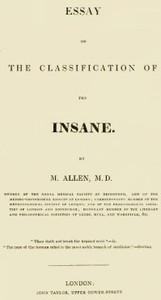
Essay on the Classification of the Insane Book Summary
Introduction
The late 18th and early 19th centuries saw profound shifts in thinking about mental illness, moving from ideas of demonic possession and moral failing towards more clinical and scientific approaches. Among the key figures driving this change was John Conolly (1749-1832), a British physician and philanthropist. His book, 'An Essay on the Classification of the Insane', published in 1813, is a landmark text in the history of psychiatry and represents a significant departure from the prevailing views of his time. It champions what would later become known as the 'moral treatment' of mental disorders, laying the groundwork for more humane approaches in asylums and fundamentally questioning the very nature of insanity itself.
What is this book about?
Conolly's essay challenges the dominant physical theories of mental illness prevalent in the late 18th century, which often linked insanity directly to bodily humors, phrenology, or constitutional defects. Instead, he proposes a classification system rooted in moral philosophy and the circumstances of the patient's life. He argues that madness is not merely a physical ailment but is significantly influenced by external factors, social conditions, and the moral state of the individual. Conolly advocates for a radical shift in how the insane are treated, moving away from punishment, neglect, or harsh physical restraints towards a more compassionate, individualized approach based on understanding the patient's history, temperament, and the specific causes of their disorder, both physical and moral. The book outlines a typology of insanity, suggesting that different forms of mental disturbance require different considerations and treatments, emphasizing the importance of kindness, respect, and appropriate environment.
Key Lessons
One of the most revolutionary ideas presented in Conolly's essay is the primacy of moral and social factors over purely physical ones in explaining mental illness. He meticulously argues that poverty, injustice, abuse, neglect, and sudden shocks to one's circumstances are major contributors to what we would now recognize as mental distress. For example, he suggests that a person driven to despair by financial ruin or the loss of a loved one might exhibit symptoms resembling melancholia, but these are fundamentally responses to extreme misfortune rather than incurable bodily diseases. This perspective was radical at the time, as most treatments focused on purging the body or resorting to confinement without much regard for the individual's background or feelings.
Secondly, Conolly introduces the concept of 'moral treatment' as the cornerstone of managing the insane. This is not a clinical term in the modern sense, but rather an approach emphasizing the moral worth and dignity of the patient. He argues that the treatment should be based on kindness, patience, and respect, tailored to the individual's specific needs and history. He believed that the environment of the asylum should be one that encourages reflection, discourages vice, and promotes a return to useful habits and society whenever possible. This idea that treatment should be humane and individualized, rather than merely physical or punitive, is a foundational concept that shaped the evolution of psychiatric care.
Thirdly, the book advocates for a more systematic approach to diagnosing mental disorders through classification. Conolly suggests grouping patients based on common symptoms, causes (physical or moral), and presumed temperaments, moving away from vague diagnoses or general labels. While his specific classifications may seem rudimentary by today's standards, the act of systematically categorizing insanity itself was a significant step towards the development of modern psychiatric nosology (the systematized classification of mental disorders). He emphasizes the importance of understanding the patient's 'state of mind' and the particular circumstances surrounding their condition.
Is this book fit for me?
This book is highly recommended if you are interested in the history of psychiatry, mental health, or the social sciences, particularly the Enlightenment and Romantic periods. It offers valuable insights into the transition from pre-scientific to more formalized ways of thinking about mental illness. If you are a student or researcher in psychology, history, philosophy, or the history of medicine, this text provides crucial context for understanding the origins of modern psychiatric thought and the concept of moral treatment. Readers interested in the history of asylums, the development of clinical care, or the ethical debates surrounding mental health will find Conolly's arguments and his critique of contemporary practices particularly relevant. It is also a fascinating read for those curious about the intellectual climate of late 18th-century England and the social conditions that shaped early ideas about human behavior and suffering.
Does it still matter today?
Yes, absolutely. John Conolly's 'Essay on the Classification of the Insane' remains profoundly relevant despite being written over two hundred years ago. The fundamental questions it posed about the causes of mental distress – the interplay between individual suffering, social injustice, and personal history – continue to be central to our understanding and treatment of mental health issues today. While the scientific understanding has advanced significantly, the core ethical concern highlighted by Conolly – the need for humane treatment, dignity, and individualized care for people experiencing mental health problems – remains a critical challenge and goal in mental health services worldwide. His advocacy for treating the 'insane' with kindness and respect rather than fear and punishment laid an essential groundwork for the deinstitutionalization movement and modern psychosocial interventions that prioritize the person within their social context. The book serves as a powerful reminder of where our field has come from and the enduring importance of ethics in mental health care.
Therefore, if you are interested in exploring further the history and philosophy of psychiatry, particularly concerning the evolution of humane care, I would suggest reading Asylums by David Rosenhan.
| Reading on Gutenburg | Free reading |
| Get Paperback Version on Amazon | Buy a book |
| Suggest Book : Asylums Book | Get on Amazon |
Conclusion
John Conolly's 'Essay on the Classification of the Insane' is a pivotal yet often overlooked text in the history of mental health. It represents a crucial moment when Enlightenment ideals of reason and humanity began to challenge the punitive and superstitious approaches to madness. By foregrounding moral and social causes, advocating for individualized and compassionate treatment, and proposing a systematic classification, Conolly's work was far ahead of its time. It powerfully illustrates the potential for reform within the medical establishment and serves as a foundational text for understanding the ethical dimensions of caring for individuals with mental health conditions. Studying this book provides invaluable context for appreciating both the progress made in mental health care and the ongoing struggle to ensure dignity, respect, and effective, humane treatment for all. Tags : Health & Medicine Psychiatry/Psychology