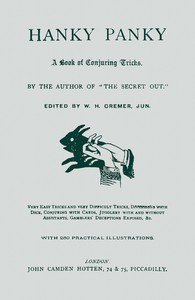
Hanky Panky Book Summary
Introduction
"Hanky Panky" is a collection of erotic stories published in the early 20th century, often anonymously. It represents a specific subgenre of Victorian and Edwardian literature that catered to a hidden audience seeking explicit content, albeit through the stylistic conventions of the time. These stories, while shocking by modern standards, are products of their era, reflecting the complex social norms and underlying currents of desire that existed beneath the surface of respectable society.
What is this book about?
"Hanky Panky" is literally about explicit sexual encounters and desires. The stories depict a range of sexual acts and scenarios, often involving characters from the upper-middle class or aristocracy, navigating the strict sexual mores of the Victorian and Edwardian periods. The narratives frequently use euphemisms, coy descriptions, or indirect suggestion characteristic of the time, attempting to disguise the explicit nature while still conveying the desired level of titillation or arousal. The central theme revolves around the exploration of taboo desires, the pursuit of forbidden pleasure, and the tension between societal restraint and personal inclination within a rigid class structure.
Key Lessons
Although written primarily for explicit content, "Hanky Panky" offers insights into its historical context:
1. The Nature of Obscurity and Taboo: The book demonstrates how language and narrative conventions could be used to explore and express taboo subjects. The elaborate euphemisms, focus on suggestive situations rather than direct description, and often ambiguous endings reveal a sophisticated attempt to operate within the boundaries of censorship and societal decency while still delivering on the promise of titillation. This teaches us about the inherent challenges and creative strategies involved in discussing sex outside the accepted discourse of the time.
2. Exploring Desires Through Indirection: The stories highlight how desire and sexuality could be explored indirectly through narrative, character interactions, and atmospheric suggestion rather than explicit depiction. This indirectness, while necessary for its time, also reflects a broader cultural tendency to hint at rather than fully articulate human sexuality, forcing the reader to engage their imagination. It serves as an interesting case study in how literature can circumvent explicitness to explore the deepest human drives.
3. Reflection of Social Constraints: The characters' actions, however illicit, are often framed within the context of their social standing. This suggests that class distinctions and societal expectations played a significant role in shaping individual sexual expression. The book indirectly explores how even in an era of burgeoning individualism, social structures and the fear of scandal heavily constrained personal freedom and the open expression of sexuality.
4. Historical Evolution of Sexual Norms: Reading "Hanky Panky" provides a stark contrast to modern understandings and depictions of sexuality. It serves as a window into the specific anxieties, attitudes, and unspoken conventions regarding sex in the early 20th century. By examining the differences in language, themes, and social context, we can better appreciate how discussions of sex have evolved, become more open (though not always less complex), and how our own contemporary understandings are shaped by historical progression.
Is this book fit for me?
This book is likely suitable if:
- You are interested in the history of sexuality or erotic literature.
- You are a student of literature, particularly focusing on Victorian/Edwardian England or the history of censorship.
- You enjoy analyzing the social and cultural context behind historical texts.
- You have a tolerance for sexually explicit content presented through the lens of historical period-piece conventions.
It may not be suitable if:
- You are easily offended by depictions of explicit sexual content, even if historically contextualized.
- You are only seeking contemporary erotic fiction.
- You are uncomfortable with historical narratives that rely on euphemism and suggestion.
- You are looking for purely literary merit without explicit themes.
Does it still matter today?
Yes, "Hanky Panky" and books like it still matter today. They provide invaluable historical perspective on:
- The evolution of sexual norms, taboos, and discourse over time.
- The complex relationship between literature, censorship, and social control.
- The ways in which desire and sexuality have been represented in different historical contexts.
- The enduring human fascination with exploring the boundaries of propriety and pleasure.
Understanding these historical perspectives helps us critically examine our own contemporary attitudes towards sex, relationships, and morality, recognizing that these are not static but constantly evolving aspects of human society.
| Reading on Gutenburg | Free reading |
| Get Paperback Version on Amazon | Buy a book |
| Suggest Book : The Sexual Behavior of the American Woman Book | Get on Amazon |
Conclusion
"Hanky Panky" offers more than just titillating reading; it serves as a fascinating, albeit sometimes uncomfortable, artifact for understanding the hidden world of sexual expression and desire in early 20th-century Britain. While its explicit content requires careful consideration, its historical and cultural insights remain relevant for scholars and curious readers interested in the history of sexuality, literature, and social mores. It reminds us that exploring the complexities of human desire has always been a challenge, whether bound by the prudery of Victorianism or the complexities of our own modern world.