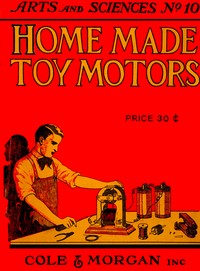
Home-made Toy Motors A practical handbook giving detailed instructions for building simple but operative electric motors Book Summary
Welcome to the summary of Home-made Toy Motors! This book, written by A. Frederick Collins, is a practical handbook that provides detailed instructions for building simple but operative electric motors. First published in 1914, it offers a glimpse into the early days of electrical engineering and DIY projects. Throughout the summary, we will explore the key lessons and concepts presented in the book, and evaluate its relevance for modern readers.
Home-made Toy Motors is a step-by-step guide to constructing small electric motors using basic materials and tools. It is designed for hobbyists and enthusiasts who want to understand the principles of electromagnetism and motor operation. The book covers various types of motors, including the simplest form of motor, the Series Motor, and more complex designs like the Two-pole Induction Motor. It also includes instructions for building accessories such as a Commutator and a Field-Magnet.
- Lesson 1: Understanding Electromagnetism
The book begins by explaining the basic principles of electromagnetism, which are essential for building electric motors. It describes how a current-carrying wire creates a magnetic field and how this field can interact with other magnets to produce motion. This is the fundamental concept behind all electric motors.
- Lesson 2: Building a Simple Motor
The book provides detailed instructions for constructing a Series Motor, which is the simplest type of electric motor. It involves winding a coil of wire around a core and connecting it to a battery and a switch. When the switch is closed, the coil becomes an electromagnet and is attracted to a permanent magnet, causing it to rotate.
- Lesson 3: Constructing More Complex Motors
After mastering the basic motor, the book guides the reader through more complex designs, such as the Two-pole Induction Motor. This type of motor uses a rotating magnetic field to induce current in the rotor, allowing for smoother and more efficient operation.
- Lesson 4: Making Accessories
In addition to motors, the book explains how to build essential accessories like a Commutator and a Field-Magnet. These components are crucial for converting the alternating current in the motor into direct current, which is necessary for the motor to run continuously.
This book is ideal for:
- Hobbyists interested in early electrical engineering and DIY projects.
- Educators looking for historical examples of motor construction.
- Students wanting to understand the basic principles of electromagnetism and motor operation.
However, it may not be suitable for those seeking modern, high-performance motor designs or advanced technical details.
Yes, Home-made Toy Motors still matters today for several reasons:
- It provides a historical perspective on the development of electric motors.
- The basic principles of electromagnetism and motor construction are still relevant and applicable.
- It offers a hands-on way to learn about electricity and magnetism through practical projects.
For those interested in further exploring modern motor designs, I recommend reading Electric Motors and Drives: Fundamentals, Types and Applications by Austin Hughes and Bill Drury.
| Reading on Gutenburg | Free reading |
| Get Paperback Version on Amazon | Buy a book |
| Suggest Book : Electric Motors and Drives: Fundamentals, Types and Applications Book | Get on Amazon |
In conclusion, Home-made Toy Motors by A. Frederick Collins is a valuable resource for anyone interested in the early days of electrical engineering and DIY motor construction. While the designs are simple and the materials are basic, the principles they demonstrate are timeless. The book provides a solid foundation for understanding how electric motors work and offers a fun and engaging way to learn about electromagnetism. Whether you are a hobbyist, educator, or student, this book can inspire you to build your own motors and deepen your understanding of this fundamental technology.