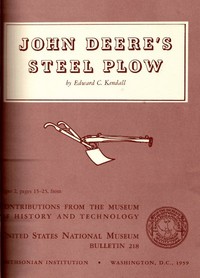
John Deere's Steel Plow Book Summary
Introduction
John Deere's Steel Plow is a historical account detailing the invention and impact of one of America's most important agricultural tools. It tells the story of John Deere, a blacksmith who, in the mid-19th century, recognized a problem in the heart of the American Midwest and created a solution that would forever change farming practices. This summary will guide you through the key events, lessons, and enduring significance of his invention.
What is this book about?
The book primarily focuses on the period around 1837 when John Deere (1808-1882) was working in Grand Detour, Illinois. Farmers there were struggling with broken wooden plows after plowing through heavy, wet sod. Deere saw this problem firsthand. He understood that a better plow needed to be harder and smoother, capable of cutting through the tough sod without crumbling itself.
Deere experimented with various materials, eventually finding that a high-carbon steel blade, shaped precisely, could do the job better than wood or cast iron. This innovation allowed farmers to cultivate the rich prairie soil of the Midwest more effectively, faster, and with less effort, significantly boosting agricultural productivity during the era of westward expansion in the United States.
The book explores the context of Deere's invention, his business development (founding the John Deere Manufacturing Company), and how his steel plow became a foundational tool in American agriculture, symbolizing ingenuity and progress.
Key Lessons
1. Solving a Real Problem Leads to Innovation: Deere didn't invent the steel plow out of thin air; he identified a specific, frustrating problem faced by farmers—their plows breaking constantly in the tough Illinois soil. His innovation wasn't just about creating something new, but finding a practical solution to a pressing need. This teaches us that true innovation often arises from understanding and addressing real-world problems, rather than just chasing novelty.
2. The Importance of Material Science and Craftsmanship: Deere's breakthrough wasn't simply about using steel; it was about the specific properties of high-carbon steel and the skill required to forge it into a precise, sharp blade. He wasn't just a blacksmith; he was an inventor who applied knowledge of materials and manufacturing to create a superior product. This highlights that successful inventions often require deep understanding and mastery of the materials and processes involved.
3. The Power of Adaptation and Improvement: Deere didn't just create a plow; he continuously improved upon his own designs. He refined the shape, the tempering process, and the overall construction based on feedback and his own observations. This iterative process of adaptation and refinement is crucial for any invention or business to achieve lasting success and market dominance.
4. Meeting Market Needs Fosters Growth: Deere's invention wasn't just a technical success; it was a commercial success because it met a critical market need. Word-of-mouth from farmers who tried his improved plow led to demand that forced him to leave his blacksmithing job and establish a factory. This demonstrates that solving a problem effectively can directly translate into business opportunities and growth.
5. Timing and Context Matter: Deere's invention occurred during a crucial period of American expansion—settlers moving west needed better tools to farm the new land. His plow was perfectly timed to meet this surge in demand. This underscores the importance of understanding the broader economic and social context; an invention, no matter how good, needs the right environment to flourish.
Is this book fit for me?
- If you are interested in the history of American invention and industry, particularly the 19th century.
- If you are fascinated by stories of individual ingenuity and how one person's idea changed the world.
- If you want to understand the origins of modern agriculture in the United States.
- If you are interested in the early development of manufacturing and business.
- If you enjoy short, accessible historical narratives about specific inventions.
Does it still matter today?
Yes, absolutely. While the specific technology of the steel plow is ancient now (though Deere's specific design was revolutionary for its time), the story it represents is timeless. John Deere's Steel Plow teaches enduring principles about innovation, problem-solving, adaptation, and the intersection of technology and market needs. It demonstrates how a single, well-executed innovation can shape an industry and even a nation's development. These themes of practical invention, perseverance, and responding to demand are as relevant today as they were in the 19th century.
| Reading on Gutenburg | Free reading |
| Get Paperback Version on Amazon | Buy a book |
| Suggest Book : The Innovators Book | Get on Amazon |
Conclusion
John Deere's Steel Plow is more than just a story about a tool; it's a microcosm of American ingenuity and the impact of practical invention. It shows how identifying a problem, applying technical skill, and understanding the market can lead to remarkable change. Though perhaps a niche read for some, it offers valuable insights into the nature of innovation and the foundational tools that built a nation. The lessons about solving real problems and the enduring relevance of Deere's story make it a worthwhile read, especially for those interested in the history of technology and the American experience. If you enjoyed this, consider reading "The Innovators" to explore more significant technological advancements and the people behind them in the modern era.