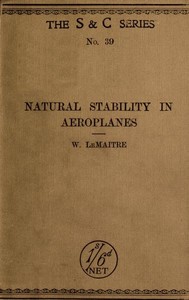
Natural Stability and the Parachute Principle in Aeroplanes Book Summary
The book "Natural Stability and the Parachute Principle in Aeroplanes" by G. T. R. Hill and C. H. Latimer-Needham, published in 1914, explores the principles of natural stability in aircraft design, focusing on the concept of the "parachute principle" to achieve inherent stability in flight. The authors present their ideas and findings, aiming to contribute to the development of safer and more stable aircraft.
This book is primarily about the concept of natural stability in aircraft design, specifically focusing on the "parachute principle." The authors discuss the importance of stability in flight and propose methods to achieve it through the aerodynamic design of aircraft, particularly by incorporating features that mimic the stability of a parachute. They explore the theoretical and practical aspects of this principle, including the use of a "slotted wing" and the role of the tailplane in maintaining stability.
- Natural Stability: The book emphasizes the importance of natural stability in aircraft design, arguing that an aircraft should be inherently stable without constant pilot input. The authors believe that this can be achieved through careful aerodynamic design, particularly by incorporating features that mimic the stability of a parachute.
- The Parachute Principle: The central concept of the book is the "parachute principle," which refers to the inherent stability of a parachute due to its shape and the distribution of its weight. The authors argue that by designing aircraft with similar aerodynamic characteristics, it is possible to achieve natural stability in flight.
- Slotted Wing: The authors propose the use of a "slotted wing" as a means to achieve natural stability. A slotted wing is a wing design that incorporates a gap or slot along its leading edge, which helps to control airflow and improve stability. The book discusses the theoretical and practical aspects of this design.
- Role of the Tailplane: The book also explores the role of the tailplane in maintaining stability. The authors argue that the tailplane can be used to counteract the destabilizing effects of the main wing, helping to keep the aircraft level and stable in flight.
- Experimental Evidence: The book presents experimental evidence to support the authors' theories, including wind tunnel tests and flight tests of aircraft designed with the parachute principle in mind. The results of these tests are used to validate the authors' claims about the effectiveness of their design principles.
This book is suitable for readers interested in the history of aircraft design, particularly the development of stability concepts. It is also relevant for those studying aerodynamics and the principles of flight. The book provides a detailed exploration of the "parachute principle" and its application in aircraft design, making it a valuable resource for anyone interested in the evolution of aircraft stability.
While the specific design principles discussed in this book are no longer widely used in modern aircraft, the underlying concepts of natural stability and the importance of aerodynamic design remain relevant. Modern aircraft design has evolved to incorporate more advanced technologies and materials, but the fundamental principles of stability and control are still based on the same aerodynamic principles discussed in this book.
| Reading on Gutenburg | Free reading |
| Get Paperback Version on Amazon | Buy a book |
| Suggest Book : Aerodynamics for Naval Aviators Book | Get on Amazon |
"Natural Stability and the Parachute Principle in Aeroplanes" is a historical document that provides valuable insights into the early development of aircraft stability concepts. While some of the specific design principles discussed are no longer in use, the book's exploration of the fundamental principles of aerodynamics and stability remains relevant to modern aircraft design. For those interested in the history of aviation and the evolution of aircraft design, this book is a valuable resource.