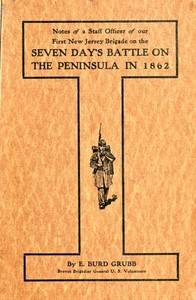
Notes of a staff officer of our First New Jersey Brigade on the Seven Day's Battle on the peninsula in 1862 Book Summary
Notes of a Staff Officer offers a remarkably detailed, firsthand account of the Peninsula Campaign, specifically the Seven Days Battles, fought in the summer of 1862. Written by a member of the First New Jersey Brigade, the book isn't a grand strategic overview, but rather a ground-level perspective, focusing on the experiences of the soldiers and the chaotic reality of combat. It's a valuable primary source for anyone interested in the Civil War, offering a vivid and often brutal depiction of the conflict.
The book meticulously chronicles the movements, engagements, and daily life of the First New Jersey Brigade as they participate in the Seven Days Battles. The author, who remained anonymous for many years (later identified as Major Henry Wilson), provides a day-by-day, sometimes hour-by-hour, account of the fighting around Mechanicsville, Gaines’s Mill, Savage’s Station, and Malvern Hill. Beyond the battles themselves, the narrative delves into the logistical challenges, the impact of leadership decisions (both good and bad), and the sheer human cost of war. It's a story of courage, confusion, and the relentless struggle for survival.
One of the most striking lessons from Notes of a Staff Officer is the overwhelming chaos and uncertainty of battle. The author repeatedly emphasizes how quickly situations could change, how orders were often misinterpreted or lost, and how reliant soldiers were on their immediate superiors for direction. He describes instances where units became separated, fought without clear objectives, and were forced to rely on their own initiative. This wasn't a war of neat maneuvers and predictable outcomes; it was a brutal, messy affair where improvisation and luck often played a larger role than strategy. For example, the confusion at Gaines’s Mill, where attacks were uncoordinated and units stumbled into each other, highlights this point vividly.
The book also powerfully illustrates the importance of leadership at all levels. Wilson praises officers who demonstrated courage, competence, and a genuine concern for their men, while sharply criticizing those who were indecisive, reckless, or absent from the field. He notes how a strong, visible leader could inspire confidence and maintain order amidst the confusion, while a weak or cowardly one could quickly lead to disaster. The contrast between the effective leadership displayed by some commanders and the failures of others is a recurring theme, demonstrating that victory often hinged on the quality of those in charge. The author's observations on General McCall, for instance, reveal a leader respected for his professionalism and bravery.
Furthermore, Notes of a Staff Officer provides a sobering look at the horrors of war and its impact on the individual soldier. Wilson doesn't shy away from describing the gruesome details of battlefield injuries and the emotional toll that combat takes on men. He recounts stories of bravery and sacrifice, but also of fear, exhaustion, and despair. The book emphasizes the immense suffering endured by the soldiers, both physically and psychologically, and challenges any romanticized notions of warfare. The descriptions of the aftermath of battles, littered with the dead and dying, are particularly harrowing and underscore the human cost of the conflict.
Finally, the book highlights the critical role of logistics in sustaining a military campaign. Wilson details the constant struggles to provide the troops with food, ammunition, and medical supplies. He points out how breakdowns in the supply chain could severely hamper military operations and undermine morale. The Peninsula Campaign, with its logistical difficulties due to weather and terrain, serves as a stark reminder that even the most brilliant strategy can fail if the army isn't properly supported. The author's accounts of foraging for supplies and the desperate need for clean water illustrate these challenges.
This book is ideal for:
- Readers interested in a detailed, ground-level account of the Civil War.
- Those seeking a primary source perspective on the Peninsula Campaign and the Seven Days Battles.
- Individuals fascinated by military history and the realities of 19th-century warfare.
- Readers who appreciate vivid descriptions and a focus on the experiences of individual soldiers.
- Anyone wanting to understand the challenges of command and logistics during the Civil War.
Yes, absolutely. The lessons about the fog of war, the importance of leadership, the human cost of conflict, and the critical role of logistics remain profoundly relevant to modern military operations and strategic thinking. The book's emphasis on the unpredictable nature of battle and the need for adaptability is particularly valuable in today's complex security environment. Understanding how these factors played out in the past can help us to better prepare for and respond to the challenges of the future.
To further explore the themes of leadership and the complexities of war, I recommend reading:
| Reading on Gutenburg | Free reading |
| Get Paperback Version on Amazon | Buy a book |
| Suggest Book : Team of Teams: New Rules of Engagement for a Complex World Book | Get on Amazon |
Notes of a Staff Officer is a powerful and insightful account of a pivotal moment in American history. While focused on a specific campaign, the book offers universal lessons about the nature of war, the importance of leadership, and the resilience of the human spirit. It's a challenging but rewarding read that will leave you with a deeper appreciation for the sacrifices made by the soldiers who fought in the Civil War.