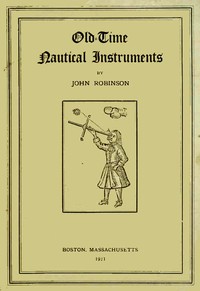
Old-Time Nautical Instruments Book Summary
"Old-Time Nautical Instruments" is a fascinating, albeit challenging, 1898 publication by John M. Lynch. It serves as a comprehensive guide to the navigational tools used by mariners before the advent of modern electronics. While not a fictional story, it meticulously details the design, function, and usage of various instruments crucial for sea navigation during that era, blending technical instruction with historical context.
This book is fundamentally a technical manual and historical overview focused on the practical aspects of maritime navigation in the 19th century. Lynch delves into instruments like the sextant (for measuring celestial bodies), chronometer (for accurate timekeeping), compasses (magnetic and gyrocompass), log (for speed and distance), and depth finders (lead line and sounding lead). The text explains the scientific principles behind each instrument, how to construct or use them, their limitations, and the techniques required for accurate navigation based on these tools. It's less of a narrative and more of an encyclopedic exploration of pre-modern seafaring technology.
This book, despite its technical nature, offers valuable insights. **Lesson 1: The Ingenuity of Pre-Modern Engineering:** It showcases the remarkable resourcefulness required to navigate vast oceans with limited technology. For example, the sextant, a relatively simple optical device, allowed sailors to determine their latitude by measuring the sun or stars' angle above the horizon. Similarly, accurate timekeeping via chronometer was essential for calculating longitude, a complex feat achieved without atomic clocks or GPS. **Lesson 2: Deep Scientific Understanding Drives Practical Solutions:** Nautical instruments are not just clever gadgets; they are the application of fundamental physics and astronomy. The book explains how principles of optics, magnetism, gravity, and celestial mechanics were translated into functional tools. Understanding how a sextant uses reflection and refraction, or how a chronometer maintains accurate time despite ship movement, reveals the depth of scientific knowledge required. **Lesson 3: Navigational Challenges Mirror Modern Ones:** The errors, complexities, and need for skilled interpretation inherent in old instruments echo issues in today's data-driven world. Relying on imprecise tools demanded careful observation, cross-referencing data, and critical thinking – skills still vital when interpreting complex information. **Lesson 4: Appreciating Historical Context Broadens Perspective:** Seeing the evolution of navigation highlights how technological progress builds incrementally. Each instrument described was often a precursor to the next, demonstrating the problem-solving journey humanity undertook to explore the oceans.
This book is ideal if: * **You are interested in the history of technology or science.** * **You have a specific need to understand or replicate historical navigation instruments.** (Requires strong technical aptitude) * **You are willing to engage with a dense, technical, and somewhat dated text.** * **You possess a good grasp of basic mathematics and physics.** * **You are a dedicated history buff focused on maritime themes.** Otherwise, it might be too specialized or challenging for casual readers.
Yes, the book remains relevant. It provides a foundational understanding of the principles underlying modern navigation, even as the tools have changed dramatically. Understanding the limitations and methods of the past helps appreciate the sophistication of GPS and other satellite systems, and the scientific principles involved are still fundamental. However, the specific instruments and techniques described are largely obsolete for practical navigation today.
| Reading on Gutenburg | Free reading |
| Get Paperback Version on Amazon | Buy a book |
| Suggest Book : Longitude: The True Story of a Lost Continent Book | Get on Amazon |
"Old-Time Nautical Instruments" offers a concentrated, technical dive into the tools that enabled ocean exploration. While demanding patience and background knowledge, it rewards readers with a deep appreciation for the ingenuity, scientific rigor, and sheer determination required for pre-electronic navigation. It stands as a testament to human problem-solving against the vastness of the sea, providing historical context and fundamental principles that connect past and present navigation.