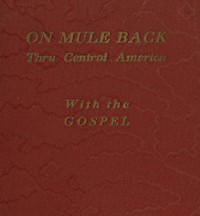
On Mule Back Thru Central America with the Gospel Book Summary
Introduction
R. Earl Thompson's On Mule Back Thru Central America with the Gospel offers a fascinating glimpse into mid-20th-century missionary work. This isn't just a travelogue; it's a firsthand account of a dedicated journey undertaken to spread the Christian faith through the less-traveled landscapes of Costa Rica and Panama. Written with a blend of earnestness, humor, and keen observation, the book captures the spirit of adventure and the challenges of cross-cultural communication during a pivotal time in evangelical expansion. It's a story of faith, perseverance, and the unique way one man attempted to bridge geographical and cultural divides using the most basic of tools—a mule and the message of the Gospel.
What is this book about?
The book chronicles R. Earl Thompson's approximately year-long journey through Costa Rica and Panama. He rode mules, often accompanied by his wife and sometimes colleagues, traversing rugged terrain, remote villages, and major cities. The core purpose of his journey was missionary: to share the Gospel with the local populations. The narrative details his experiences—both the successes and failures of his evangelistic efforts, the friendships formed, the cultural misunderstandings encountered, the logistical challenges faced, and the profound observations about the people and landscapes he encountered. It's a raw, unfiltered account of dedicated service in the field during the 1950s.
Key Lessons
This book, while a product of its time and place, offers several enduring insights relevant to mission work and cultural engagement.
Firstly, it emphasizes the power of contextualized presence. Thompson wasn't just dropping sermons in villages; he was living among the people, sharing their hardships (or trying to), and building relationships. His reliance on mules made him relatable to the rural populations he aimed to reach, bypassing the often-imposing presence of modern missionaries. This immersion allowed for more authentic interaction, though not always successful, demonstrating that proximity and shared experience are foundational to effective cross-cultural communication.
Secondly, the book highlights the necessity of prayer and discernment. Thompson frequently mentions prayer as the bedrock of his work and personal struggles. He shares moments of doubt, frustration with limited results, and the need to discern God's guidance in uncertain situations. This underscores that missionary work isn't just about action but also about reliance on spiritual resources and careful consideration of context and methods.
Thirdly, it teaches about the practicalities and limitations of field work. The book doesn't shy away from the difficulties—bad roads, difficult terrain, limited resources, and the sheer physical and emotional toll of the journey. It shows that effective mission isn't glamorous; it requires resilience, adaptability, and a willingness to face discomfort and potential failure. Thompson's resourcefulness in dealing with these challenges provides a realistic picture of missionary life.
Fourthly, Thompson's approach, while earnest, wasn't always culturally sophisticated. He sometimes misinterpreted customs or assumed Western values were universal. This serves as a gentle reminder that even well-intentioned outsiders can be culturally naive. It encourages humility and a continuous learning process, recognizing that the locals often hold the key to understanding their own context.
Finally, the book subtly explores the diversity of responses to the Gospel. It presents a spectrum—from enthusiastic conversions and meaningful discussions to polite but non-committal responses and outright rejection. This teaches that evangelism involves encountering people where they are, respecting their worldview, and not expecting uniform results, focusing instead on faithful proclamation and relationship-building.
Is this book fit for me?
This book would be particularly suitable if:
- You are interested in the history of 20th-century American evangelicalism and missionary movements.
- You enjoy travel narratives or anthropological accounts of lesser-known regions like Central America in the mid-20th century.
- You want to understand the practical realities and challenges of cross-cultural ministry from a historical perspective.
- You appreciate stories of faith, perseverance, and human endeavor in challenging circumstances.
- You are willing to read a text that is earnest, sometimes dated in its assumptions, but provides a valuable primary source account.
Does it still matter today?
Yes, this book still holds relevance today, though its specific context differs significantly. While the methods and perhaps the target audience for many missionaries have evolved, the core challenges of cross-cultural communication, the importance of contextualization (even if imperfectly in this case), the necessity of prayer and discernment, the need for resilience, and the diversity of responses to the Gospel message remain profoundly relevant. Thompson's account provides a tangible, human-scale perspective on the complexities and motivations behind missionary work, offering valuable historical background and reminding readers of the foundational principles that often underpin modern cross-cultural engagement, even if the practical implementation looks very different now.
| Reading on Gutenburg | Free reading |
| Get Paperback Version on Amazon | Buy a book |
| Suggest Book : In Search of Jesus: A Social Network Analysis Book | Get on Amazon |
Conclusion
R. Earl Thompson's On Mule Back Thru Central America with the Gospel is more than just a historical artifact; it's a compelling human story intertwined with a spiritual quest. Through its honest depiction of struggles, successes, cultural encounters, and unwavering faith, the book offers valuable insights into a specific era of missionary work. It remains relevant for understanding the enduring complexities of sharing faith across cultural divides. While perhaps less focused on contemporary social network analysis than the suggested book, it provides a foundational appreciation for the human element central to any cross-cultural endeavor.