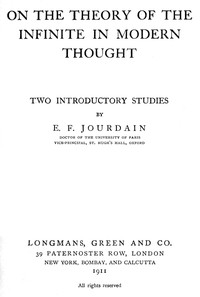
On the theory of the infinite in modern thought Book Summary
Introduction
Felix Klein's On the Theory of the Infinite in Modern Thought, originally published in 1928, delves into the complex and often abstract concept of infinity, exploring its multifaceted role in mathematics and beyond. This text is not merely a treatise on the infinite; it's a profound reflection on the philosophy, foundations, and pedagogy of mathematics, particularly through the lens of how infinity has been perceived and utilized. Written during a time when set theory, championed by Georg Cantor, was revolutionizing mathematics and sparking intense philosophical debate, Klein offers a perspective that bridges the gap between rigorous mathematical inquiry and its broader implications for education and intellectual thought.
What is this book about?
Klein, a towering figure in 19th and early 20th-century mathematics and a proponent of linking mathematical research with educational practice, uses the concept of infinity as a central theme to discuss the state and future of mathematics. He examines the historical development of ideas regarding infinity, critiques the emerging Cantorian set theory, and argues for a more geometric and intuitive approach to understanding mathematical concepts. The book reflects his belief that mathematics should be accessible and connected to real-world thought processes, advocating for an educational system that fosters geometric intuition alongside abstract reasoning. It's an exploration of how infinity permeates mathematics (from projective geometry to calculus) and how grappling with it shapes mathematical thinking and pedagogy.
Key Lessons
Distinguishing Potential from Actual Infinity: Klein meticulously distinguishes between these two concepts. Potential infinity refers to a process that continues indefinitely (like counting numbers forever) without ever reaching a final state. Actual infinity, conversely, treats the infinite as a completed totality (like the set of all natural numbers). Klein argues that many paradoxes and difficulties in modern mathematics arise from confusing or prematurely invoking actual infinity where potential infinity is sufficient. He champions the power of potential infinity, seeing it as a more intuitive and philosophically sound way to approach mathematical limits and processes.
Making Infinity Accessible and Geometric: A central theme is Klein's advocacy for making the concept of infinity understandable through geometric intuition and visual thinking. He believed that abstract set theory, while powerful, could alienate students and obscure the underlying geometric and dynamic aspects of mathematics. He explores how infinity manifests in projective geometry (points at infinity) and the behavior of infinite series, suggesting pedagogical approaches that leverage spatial and kinematic intuitions rather than solely relying on symbolic manipulation.
The Role of Infinity in Mathematical Development: Klein traces the historical roots of infinity in mathematics, from ancient Greek paradoxes (Zeno's) to the infinitesimals of the 17th-century calculus (developed independently by Newton and Leibniz) and up to the set-theoretic foundations. He sees infinity not as a fringe concept but as integral to the evolution of mathematical ideas, pushing boundaries and revealing the need for new axioms and frameworks (like Cantor's work, which he both appreciates and critiques).
Caution against Cantor's Set Theory: While Klein respects Cantor's groundbreaking work on different sizes of infinity, he expresses reservations. He questions the philosophical justification for treating infinite sets as actual completed entities and worries about the paradoxes that emerged from set theory (like Russell's paradox). His critique stems partly from a pedagogical concern: he feared that Cantor's highly abstract approach could hinder the understanding and appreciation of mathematics among a broader audience.
Is this book fit for me?
This book is particularly suitable for:
- Students and educators interested in the history of mathematics and the philosophy of mathematics.
- Those studying the foundations of mathematics or the development of mathematical concepts.
- Individuals with a strong mathematical background who are curious about the pedagogical implications of advanced concepts like infinity.
- Readers interested in Felix Klein's specific views on mathematical education and the role of intuition.
However, it might be challenging for readers seeking a rigorous, modern introduction to set theory or the technical details of different cardinalities of infinity (Cantor's work is mentioned but not the focus). Its style is reflective and less technical than a modern monograph on set theory, more concerned with conceptual clarification and educational philosophy.
Does it still matter today?
Yes, Felix Klein's Theory of the Infinite remains relevant today. It offers valuable historical context for understanding the ongoing debates surrounding mathematical foundations, the nature of infinity, and the relationship between different mathematical disciplines. His emphasis on intuition, geometric thinking, and pedagogy continues to inform discussions about mathematics education and the accessibility of advanced concepts. While modern mathematics has embraced Cantor's set theory as a standard foundation, Klein's critique highlights the importance of maintaining connections between abstract formalisms and intuitive understanding. He reminds us that mathematical concepts, even foundational ones like infinity, should be pursued with clarity, a sense of purpose, and consideration for their broader intellectual and educational impact.
| Reading on Gutenburg | Free reading |
| Get Paperback Version on Amazon | Buy a book |
| Suggest Book : Infinity: Not a Threat but a Tool Book | Get on Amazon |
Conclusion
Felix Klein's Theory of the Infinite is a significant work that transcends its historical context. It successfully intertwines mathematical content with deep philosophical and educational reflections. By examining the concept of infinity through the lens of its history, applications, and pedagogical implications, Klein provides not just an analysis of a mathematical idea, but a commentary on the nature and goals of mathematical activity itself. While it doesn't offer the technical depth of modern set theory texts, it provides invaluable perspective on how mathematical ideas evolve, the tensions between different approaches, and the crucial role of intuition and clarity in mathematics. It remains a thought-provoking read for anyone interested in the foundations, history, or philosophy of mathematics. Tags : Mathematics Philosophy & Ethics