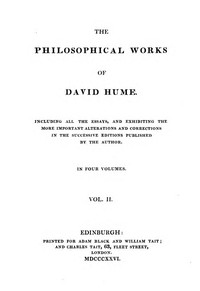
Philosophical Works, v. 2 (of 4) Including All the Essays, and Exhibiting the More Important Alterations and Corrections in the Successive Editions Published by the Author Book Summary
Introduction
Welcome to a summary of Volume 2 of David Hume's collected philosophical works. This volume, like its predecessors and successors, presents a selection of Hume's essays and treatises, crucially noting the revisions and alterations Hume made in successive editions. It's not just a collection of ideas; it's a fascinating look at how Hume himself refined his thinking over time, showcasing the evolution of his philosophical arguments and conclusions.
What is this book about?
This specific volume compiles key essays from Hume's philosophical output, including foundational works like "Of the Senses" and "Of Personal Identity." Its unique feature is detailing the significant changes Hume made between editions. For instance, you'll see how his arguments matured, how certain positions hardened or softened, and how he corrected perceived weaknesses. It's about tracing Hume's intellectual journey and seeing his philosophy not as a static system, but as a dynamic, evolving thought process documented by the author himself.
Key Lessons
Hume's work fundamentally reshaped Enlightenment philosophy. One central lesson is his radical empiricism: true knowledge comes solely from experience. He famously divided all objects of thought into two categories: "relations of ideas" (like mathematics, which are true by reason alone) and "matters of fact" (like observing the world, which depend on experience and probability). This "copy principle" asserts that our mind merely copies sensory impressions to form ideas. Another key insight is his Bundle Theory of the self, arguing there's no permanent, unified self, only a "bundle" of perceptions linked by association. He also profoundly critiqued the idea of innate ideas and the existence of God as a necessary being, relying instead on probabilistic reasoning and skepticism about metaphysical claims. His ethical naturalism suggests morality arises from sentiment, not reason, famously stating that "reason is, and ought only to be the slave of the passions."
Is this book fit for me?
This volume is ideal if you are already familiar with basic philosophical concepts and are specifically interested in the historical development of philosophical arguments, particularly Hume's. You will appreciate seeing the revisions because they reveal the intellectual struggle and refinement behind his ideas. It's less suitable as an introduction to Hume's philosophy or as a beginner's guide, as the focus is on the text itself and its evolution, assuming some prior knowledge. It requires patience to follow the textual variations and understand the context of each change.
Does it still matter today?
Yes, absolutely. Hume's ideas are foundational for modern philosophy, psychology, economics, and even the scientific method. His skepticism about innate knowledge and his emphasis on empirical observation underpin much of scientific inquiry. His Bundle Theory of the self remains a cornerstone in discussions of personal identity in philosophy and psychology. His naturalistic account of morality continues to influence ethical debates, especially regarding the role of emotion versus reason. Understanding his principles provides essential context for later philosophers like Kant, who engaged directly with Hume's ideas.
| Reading on Gutenburg | Free reading |
| Get Paperback Version on Amazon | Buy a book |
| Suggest Book : The History of Western Philosophy Book | Get on Amazon |
Conclusion
Volume 2 of Hume's collected works, with its focus on revisions, offers a unique perspective on one of philosophy's most influential figures. It requires a certain level of engagement with the text and its historical context, but rewards the reader with a deeper appreciation for how philosophical ideas are honed and the intellectual rigor involved. It remains essential reading for anyone seeking to understand the roots of modern thought and the enduring power of skeptical inquiry.