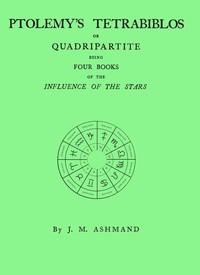
Ptolemy's Tetrabiblos Book Summary
Written in the 2nd century AD by Claudius Ptolemy, a Greco-Roman mathematician, astronomer, geographer, astrologer, and music theorist, the Tetrabiblos (meaning 'Four Books') is a foundational text in the Western astrological tradition. It's not a 'how-to' guide for daily horoscopes, but rather a comprehensive treatise attempting to establish astrology as a legitimate scientific discipline, rooted in observable astronomical phenomena and philosophical principles. Ptolemy aimed to demonstrate that astrological influences were consistent with the natural order of the universe, as understood in his time.
The Tetrabiblos systematically explores the principles of astrology, covering topics like the influence of the planets, the signs of the zodiac, the nature of aspects (angular relationships between planets), and the interpretation of nativities (birth charts). Ptolemy details how these elements interact to shape individual character and predict life events. He also discusses mundane astrology – the forecasting of events affecting entire countries or regions – and meteorological astrology, which attempts to correlate celestial events with weather patterns. Essentially, it's a detailed manual for understanding the cosmos and its perceived effects on Earthly affairs, presented as a logical and reasoned system.
The Interconnectedness of All Things: Ptolemy’s core belief is that the universe is a unified, hierarchical system. Everything is interconnected, from the celestial bodies to the weather, to human beings. He argues that the positions of the planets at the moment of birth imprint a unique signature on an individual, influencing their temperament, abilities, and destiny. This isn’t a mystical connection, but a natural one, stemming from the planets’ physical properties and their relationship to the four elements (fire, earth, air, and water). For example, Mars, being hot and dry, is associated with courage and aggression, and will manifest differently depending on the sign it occupies – more controlled in Capricorn, more impulsive in Aries.
The Importance of Planetary Dignities and Debilities: A crucial concept in the Tetrabiblos is that planets aren’t all created equal in every sign. A planet is considered ‘dignified’ when it’s in a sign it rules (like Mars in Scorpio) or in a sign that resonates with its nature (like the Sun in Leo). Dignified planets express their qualities positively and effectively. Conversely, a planet is ‘debilitated’ when it’s in a sign that clashes with its nature (like Venus in Aries). Debilitated planets struggle to function properly, leading to challenges and frustrations. Understanding these dignities and debilities is paramount to accurate interpretation. Imagine trying to build a house with faulty tools – that’s what a debilitated planet is like.
The Role of Aspects in Planetary Interaction: Ptolemy doesn’t view planets as acting in isolation. He emphasizes the importance of ‘aspects’ – the angles formed between planets in a chart. These angles represent specific types of relationships, each with its own characteristic effect. For instance, a conjunction (0 degrees) signifies a blending of energies, while a square (90 degrees) indicates tension and conflict. He meticulously details the strength and nature of each aspect, explaining how they modify and complicate the influence of individual planets. A harmonious trine aspect between Venus and Jupiter might suggest good fortune in love and finances, while a challenging opposition between Mars and Saturn could indicate obstacles in achieving goals.
Astrology as a Statistical Art: Perhaps surprisingly, Ptolemy advocates for a rigorous, observational approach to astrology. He stresses the need to collect data on many individuals and events to identify patterns and refine predictive techniques. He acknowledges that astrology isn’t foolproof and that individual charts can be complex and ambiguous. He encourages astrologers to avoid making overly specific or deterministic predictions, and instead to focus on identifying general tendencies and probabilities. This emphasis on empirical observation sets the Tetrabiblos apart from more purely speculative astrological texts.
This book is ideal for:
- Serious students of astrology: It's the foundational text for Western astrology and provides a deep understanding of its principles.
- Those interested in the history of science: It offers insight into how ancient cultures attempted to understand the natural world.
- Readers with a philosophical bent: Ptolemy’s work is deeply rooted in Aristotelian philosophy and explores the relationship between the microcosm (humanity) and the macrocosm (the universe).
- Individuals who appreciate detailed, systematic analysis: The Tetrabiblos is a meticulously organized and comprehensive treatise.
However, it's not for:
- Beginners seeking quick answers: It's a challenging read that requires patience and a willingness to grapple with complex ideas.
- Those looking for lighthearted horoscope readings: This is a serious work of scholarship, not a source of entertainment.
Yes, absolutely. The Tetrabiblos remains the cornerstone of traditional Western astrology. While modern astrology has incorporated many new techniques and perspectives (like psychological astrology), the fundamental principles outlined by Ptolemy – planetary dignities, aspects, the elemental triplicities, and the concept of a unified cosmos – are still widely used and debated by astrologers today. Its influence extends beyond astrology itself, impacting fields like history, art, and literature. The book’s enduring relevance lies in its attempt to create a coherent and meaningful framework for understanding the human condition within a larger cosmic context.
To further explore these concepts, a good next step would be to delve into a more contemporary interpretation of Ptolemy's work.
| Reading on Gutenburg | Free reading |
| Get Paperback Version on Amazon | Buy a book |
| Suggest Book : Astrology, Psychology, & the Four Elements Book | Get on Amazon |
The Tetrabiblos is a challenging but rewarding read. It’s a testament to the enduring human desire to find meaning and order in the universe. While its scientific claims are not accepted by modern science, its historical and philosophical significance remains undeniable, and its principles continue to inform and inspire astrological practice today.