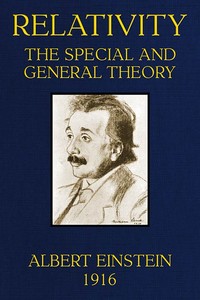
Relativity : the Special and General Theory Book Summary
Albert Einstein's Relativity: The Special and General Theory, originally published in 1916, is a landmark work in physics, and surprisingly accessible to the layperson. It's a book born from a desire to explain a revolutionary set of ideas to a public largely unfamiliar with the advanced mathematics usually associated with the topic. Einstein doesn't shy away from the core concepts, but he deliberately minimizes the complex equations, opting instead for thought experiments and clear, logical reasoning. This edition, available through Project Gutenberg, represents a significant effort to democratize understanding of one of the 20th century's greatest scientific achievements.
This book is a comprehensive, yet remarkably approachable, explanation of Einstein's theories of special and general relativity. The first part focuses on special relativity, dealing with the relationship between space and time for observers in uniform motion (constant speed in a straight line). It dismantles the classical Newtonian ideas of absolute space and time, demonstrating that measurements of these quantities are relative to the observer's motion. The second, and more challenging, part delves into general relativity, which describes gravity not as a force, but as a curvature of spacetime caused by mass and energy. Einstein explains how this curvature affects the motion of objects, including light, and provides evidence supporting his theory.
One of the most fundamental lessons is the relativity of simultaneity. Einstein illustrates this with a thought experiment involving a train and lightning strikes. What appears simultaneous to an observer on the train isn't necessarily simultaneous to an observer standing still on the ground. This isn't an illusion; it's a consequence of the constant speed of light. Imagine two lightning bolts striking the front and back of a moving train at the same time *from the perspective of someone on the train, exactly halfway between the front and back*. To someone standing still, however, the light from the bolt that struck the front of the train will reach them *before* the light from the bolt that struck the back, because the train is moving towards the light from the front and away from the light from the back. This demonstrates that 'simultaneous' is dependent on your frame of reference.
Another crucial concept is time dilation and length contraction. As an object's speed approaches the speed of light, time slows down for that object relative to a stationary observer, and its length contracts in the direction of motion. This isn't about the object physically changing, but rather how time and space are *perceived* differently depending on relative velocity. Think of a spaceship traveling at a very high speed. To people on Earth, time on the spaceship would appear to be passing slower, and the spaceship itself would appear shorter than when it was at rest. These effects are negligible at everyday speeds, but become significant as you approach the speed of light.
The book then introduces the revolutionary idea of mass-energy equivalence, expressed as E=mc². This equation states that energy (E) and mass (m) are interchangeable, with the speed of light (c) squared being the conversion factor. A small amount of mass can be converted into a tremendous amount of energy, and vice versa. This principle underlies nuclear power and nuclear weapons. It also explains why the sun shines – it's constantly converting mass into energy through nuclear fusion. Einstein emphasizes that mass isn't simply a measure of 'stuff,' but a form of energy itself.
Finally, Einstein explains gravity as a curvature of spacetime. Instead of thinking of gravity as a force pulling objects together, general relativity describes it as objects following the curves in spacetime created by massive bodies. Imagine a bowling ball placed on a stretched rubber sheet. The ball creates a dip, and if you roll a marble nearby, it will curve towards the bowling ball, not because the bowling ball is 'pulling' it, but because the marble is following the curvature of the sheet. This is analogous to how planets orbit the sun – they're following the curves in spacetime created by the sun's mass. This concept also predicts phenomena like the bending of light around massive objects, which has been experimentally confirmed.
This book is ideal for readers who:
- Have a curious mind and an interest in physics, even without a strong mathematical background.
- Want to understand the core concepts of relativity without getting bogged down in complex equations.
- Enjoy thought experiments and logical reasoning.
- Are looking for a historical perspective on one of the most important scientific theories of all time.
However, be prepared for a challenging read. While Einstein avoids heavy math, the concepts themselves are abstract and require careful consideration. It's not a light read, but the effort is well rewarded.
Absolutely. Relativity isn't just a theoretical curiosity; it's fundamental to many technologies we rely on today. GPS satellites, for example, must account for both special and general relativistic effects to provide accurate positioning. Without these corrections, GPS would be off by several kilometers per day! Furthermore, relativity is crucial for understanding the universe at large, including the behavior of black holes, the expansion of the universe, and the evolution of stars. It continues to be a cornerstone of modern physics and cosmology.
For a deeper dive into the modern implications and extensions of relativity, I suggest reading:
| Reading on Gutenburg | Free reading |
| Get Paperback Version on Amazon | Buy a book |
| Suggest Book : Black Holes and Time Warps: Einstein's Outrageous Legacy Book | Get on Amazon |
Relativity: The Special and General Theory remains a remarkable achievement in science communication. Einstein successfully conveyed his groundbreaking ideas to a broad audience, demystifying a complex subject and inspiring generations of scientists and thinkers. It's a testament to the power of clear thinking and elegant explanation, and a must-read for anyone interested in understanding the fundamental nature of space, time, and gravity.