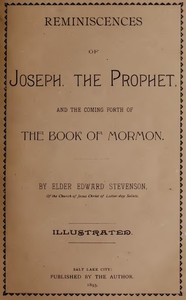
Reminiscences of Joseph, the Prophet, and the Coming Forth of the Book of Mormon Book Summary
Introduction
This summary explores "Reminiscences of Joseph, the Prophet, and the Coming Forth of the Book of Mormon," a historical account detailing the early events of the Latter-day Saint movement. The book focuses on the experiences of Joseph Smith Jr., the founder of Mormonism, and the purported appearance of divine beings who authorized and directed the translation of the Book of Mormon. Written from a perspective aligned with the beliefs of The Church of Jesus Christ of Latter-day Saints, it provides a narrative of restored religious authority and the establishment of a new scripture.
What is this book about?
"Reminiscences of Joseph, the Prophet, and the Coming Forth of the Book of Mormon" recounts the early history of Mormonism, primarily through the lens of Joseph Smith's life and the divine events surrounding the Book of Mormon's translation. It describes the First Vision, where Smith claimed to have seen God and Jesus Christ, and the subsequent visitations said to have occurred in 1823 and 1827. These visits allegedly introduced Smith to the angel Moroni, who directed him to translate ancient golden plates into the Book of Mormon, the book that would become foundational to the new religious movement Smith founded. The narrative emphasizes divine authorization, the restoration of religious principles, and the challenges faced in bringing forth this new scripture.
Key Lessons
One central theme explored in these reminiscences is the concept of divine authority and its restoration. The narrative portrays Joseph Smith not merely as a religious innovator, but as a prophet authorized by heavenly beings to restore Christ's church and bring forth scripture. This lesson highlights the LDS belief in a living prophet and divine guidance, suggesting that religious truth can be revealed and organized through direct communication with God.
Another significant lesson concerns faith and evidence. The account details specific visions and encounters (like the First Vision and the golden plates incident) as tangible, verifiable experiences that validate religious claims. This raises the question of how faith develops and what constitutes evidence for the divine, particularly through personal, extraordinary encounters. The book presents these events as foundational experiences that transformed Smith from a seeker to a religious leader.
The text also implicitly teaches about the importance of obedience and consecration. Joseph Smith's compliance with the instructions given by Moroni regarding the plates, despite the immense personal risk and labor involved, is presented as crucial. His dedication to translating the Book of Mormon, even amidst financial and social challenges, underscores the LDS belief that translating and disseminating divine truth is a paramount religious duty.
Furthermore, the narrative offers insights into the nature of scripture and revelation. It portrays the Book of Mormon not just as a historical document but as a divine gift, a companion to the Bible, providing additional scripture and restored truths. The process of translation is depicted as a miraculous act facilitated by divine power, emphasizing the idea that scripture can be revealed and brought forth in unique ways specific to each era.
Is this book fit for me?
- If you are interested in the history of the Latter-day Saint movement or Mormonism.
- If you want to understand the foundational beliefs and experiences of early Mormonism, particularly the role of Joseph Smith.
- If you are researching religious revivals, visions, or claims of divine communication in American religious history.
- If you are a member of The Church of Jesus Christ of Latter-day Saints seeking a primary source account of the Book of Mormon's origins.
- If you are curious about the concept of prophetic restoration in modern religions.
Does it still matter today?
Yes, this book and the story it tells continue to matter today. The narrative of Joseph Smith's First Vision is a cornerstone of LDS identity and theology, emphasizing that anyone can seek divine truth directly. The book provides foundational understanding for how the LDS Church came to be and why the Book of Mormon holds such central importance. It offers a perspective on the nature of divine revelation, the role of prophets, and the relationship between faith and historical events. For those interested in American religious history, it provides a fascinating, albeit highly selective and faith-based, account of a movement that profoundly shaped American religious and cultural landscapes.
| Reading on Gutenburg | Free reading |
| Get Paperback Version on Amazon | Buy a book |
| Suggest Book : A Short History of the Latter-Day Saints Book | Get on Amazon |
Conclusion
"Reminiscences of Joseph, the Prophet, and the Coming Forth of the Book of Mormon" offers a detailed, albeit distinctly LDS-particular, account of the movement's inception. It is essential reading for understanding the core beliefs and historical claims of The Church of Jesus Christ of Latter-day Saints, particularly regarding the divine authorization of Joseph Smith and the Book of Mormon. While written from a specific theological perspective, it provides valuable insight into the origins of one of America's most significant religious traditions.