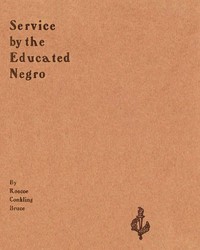
Service by the Educated Negro Address of Roscoe Conkling Bruce of Tuskegee Institute at the Commencement Exercises of the M Street High School Metropolitan A. M. E. Church Washington, D.C., June 16, 1903 Book Summary
Introduction
This summary covers Roscoe Conkling Bruce's address titled "Service by the Educated Negro," delivered at the M Street High School commencement in 1903. The speech discusses the responsibilities and potential roles of African Americans who have gained an education during a period marked by significant racial inequality and the fight for civil rights.
What is this book about?
Bruce's address focuses on the concept of "uplift"—the idea that the educated African American has a duty to elevate the race as a whole. He argues that education should not only benefit the individual but must be used to serve the community and fight against oppression. The speech emphasizes the need for African Americans to utilize their education and skills to improve their own community and to participate fully in society, despite ongoing racial barriers.
Key Lessons
1. Education as Service, Not Just Privilege: Bruce argues that an education is a powerful tool, but it comes with a responsibility. It's not merely for personal advancement or comfort. Instead, the educated individual has a moral obligation to use their knowledge and skills to uplift their race and community. This service is crucial in the face of systemic disadvantages and discrimination.
2. Community Focus and Self-Help: The speech champions self-reliance and collective progress within the African American community. Bruce suggests that educated individuals should mentor others, establish institutions (like schools and businesses), and work towards improving the economic and social standing of their people. He sees this internal development as a foundational step towards broader equality. For example, establishing schools and vocational programs empowers others and builds community resilience.
3. Active Citizenship and Overcoming Racial Barriers: Bruce calls for educated African Americans to engage actively in civic life and to use their positions to challenge prejudice and fight for rights. He acknowledges the significant obstacles but believes that education and diligent effort can help overcome them, contributing to the betterment of society at large. This involves not only excelling personally but also advocating for fair treatment and equal opportunities for others.
4. Hope and Realism: While Bruce offers a message of uplift and hope, he is also realistic about the challenges. He understands the history of oppression but believes that through persistent effort, education, and community support, progress is possible. His message is one of empowerment, urging the educated to lead the way out of disadvantage.
Is this book fit for me?
This address is particularly suitable for readers interested in:
- African American History: Especially the early 20th-century struggle for civil rights and identity.
- Historical Perspectives on Uplift: Understanding the specific ideology and motivations behind the "Talented Tenth" concept.
- Early 20th-Century Rhetoric: Analyzing speeches and arguments from that specific historical period.
- Social Justice and Activism: Exploring early models of leadership and community building in the face of systemic racism.
- Complementing Booker T. Washington's Writings: If you've read Washington, you'll see Bruce offering a slightly different, though equally important, perspective on the role of the educated class.
Does it still matter today?
Yes, to a significant extent. While the specific historical context (Jim Crow laws, segregation) is gone, the core ideas Bruce discusses remain relevant:
* **The Importance of Education for Empowerment:** Bruce's argument that education is a tool for personal and collective advancement and a means to overcome disadvantage is still fundamentally true. Education continues to be a key factor in social mobility and economic opportunity.
* **The Role of Community and Collective Action:** The emphasis on community uplift and self-help remains important. Addressing systemic inequalities often requires targeted community efforts and building strong social networks.
* **The Call for Service and Citizenship:** The idea that those with advantages (including education) have a responsibility to serve and contribute to the greater good, especially marginalized communities, is a timeless ethical principle.
However, Bruce's address, written from a specific perspective and time, also has limitations. It focuses heavily on uplifting the Black community in America, which, while crucial, doesn't address global perspectives or the interconnected nature of racial justice today in the same way contemporary analyses might.
Therefore, while insightful, it should be read alongside more recent scholarship for a fuller understanding of the ongoing struggle.
| Reading on Gutenburg | Free reading |
| Get Paperback Version on Amazon | Buy a book |
| Suggest Book : The Fire Next Time Book | Get on Amazon |
Conclusion
Roscoe Conkling Bruce's 1903 address remains a valuable historical document. It captures a crucial moment in the thinking of African American intellectuals about the purpose of education and the path forward for the race. While its specific historical context limits its direct application, its core message about the responsibility that comes with education and the importance of community uplift continues to resonate. It offers important insights into the strategies and ideologies that shaped the fight for civil rights and social justice in America. Tags : Culture/Civilization/Society History - American Teaching & Education