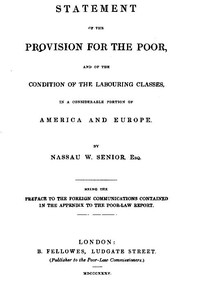
Statement of the Provision for the Poor, and of the Condition of the Labouring Classes in a Considerable Portion of America and Europe Being the preface to the foreign communications contained in the appendix to the Poor-Law Report Book Summary
Published in 1836, Statement of the Provision for the Poor, and of the Condition of the Labouring Classes in a Considerable Portion of America and Europe is a lengthy preface written by the Assistant Poor Law Commissioners for the British government. It accompanied a collection of reports on poverty and poor relief systems in various countries. While seemingly a dry, bureaucratic document, it offers a remarkably insightful and often harsh assessment of the lives of the working class and the existing methods of addressing poverty in the early 19th century.
This book isn't a narrative story, but a detailed, analytical report. It examines the causes of poverty, the existing systems of poor relief (workhouses, outdoor relief, etc.) in different nations, and the effects of those systems on the poor themselves. The Commissioners investigated conditions in France, Germany, Belgium, the Netherlands, Italy, and the United States, comparing them to the situation in England. A central goal was to inform the implementation of the New Poor Law of 1834 in Britain, which aimed to make poverty less attractive and more of a deterrent to seeking assistance.
One of the most striking lessons is the Commissioners’ firm belief in the principle of ‘less eligibility.’ They argued that poverty must be made less desirable than even the lowest-paid employment. This wasn’t out of malice, but from a conviction that providing comfortable assistance would discourage work and create a dependent underclass. They observed that systems offering generous relief often led to widespread idleness and moral decay. For example, they criticized French systems where families could receive aid at home, arguing it removed the incentive for able-bodied individuals to seek work. This idea, though controversial, fundamentally shaped the New Poor Law and its emphasis on the harsh conditions of the workhouse.
The report also highlights the devastating impact of industrialization and economic fluctuations on the working class. While acknowledging the benefits of progress, the Commissioners detailed the displacement of agricultural workers, the low wages in factories, and the cyclical nature of unemployment. They observed that even with work available, wages were often insufficient to provide a decent standard of living, particularly for families. The Commissioners noted the vulnerability of workers to economic downturns, where even a small disruption in trade could lead to mass layoffs and destitution. This demonstrates an early understanding of the structural causes of poverty, beyond simply individual failings.
Furthermore, the book reveals a strong emphasis on moral character and the perceived ‘deserving’ versus ‘undeserving’ poor. The Commissioners were deeply concerned with what they saw as a lack of thrift, industry, and self-reliance among the laboring classes. They believed that many people were poor not due to circumstances beyond their control, but because of their own bad habits and lack of foresight. This bias is evident in their descriptions of the poor and their justifications for strict regulations on relief. They contrasted the ‘industrious’ and ‘frugal’ with the ‘idle’ and ‘improvident,’ often blaming the latter for their own plight. This distinction, while problematic, was a common thread in 19th-century social thought.
Finally, the comparative analysis of different countries demonstrates the importance of a national, centralized approach to poor relief. The Commissioners found that fragmented, local systems were often inefficient, prone to abuse, and unable to address large-scale poverty effectively. They favored a uniform system with clear rules and regulations, believing it would be more equitable and less susceptible to corruption. The British Poor Law Commission itself was a manifestation of this belief in centralized control and standardized procedures.
This book is ideal for readers interested in:
- Social History: Understanding the lives of the working class in the 19th century.
- The History of Welfare: Tracing the origins of modern social security systems.
- Economic History: Examining the impact of industrialization on poverty.
- Political Theory: Exploring debates about the role of the state in providing for the poor.
- Comparative Studies: Analyzing different approaches to poverty relief across nations.
Be warned: it's a dense and detailed read, lacking the narrative flow of a typical history book. It requires patience and a willingness to engage with complex arguments.
Yes, absolutely. The debates surrounding the ‘deserving’ versus ‘undeserving’ poor, the role of incentives in welfare programs, and the challenges of balancing individual responsibility with social support are all still highly relevant today. The Commissioners’ focus on the structural causes of poverty, while limited by their time, foreshadows modern understandings of inequality and the need for systemic solutions. The concept of 'less eligibility' continues to be debated in the context of welfare reform and the design of social safety nets.
To further explore these themes, I suggest reading:
| Reading on Gutenburg | Free reading |
| Get Paperback Version on Amazon | Buy a book |
| Suggest Book : Nickel and Dimed: On (Not) Getting By in America Book | Get on Amazon |
Statement of the Provision for the Poor is a challenging but rewarding read. It provides a unique window into the thinking of 19th-century policymakers grappling with the problem of poverty, and it raises enduring questions about the nature of social responsibility and the best ways to alleviate human suffering. While its conclusions are often harsh and reflect the biases of its time, it remains a crucial document for understanding the historical roots of modern welfare states.