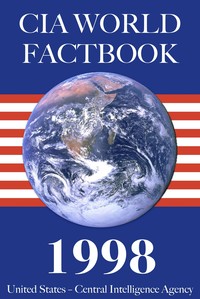
The 1998 CIA World Factbook Book Summary
Introduction
The 1998 edition of the CIA World Factbook was compiled by the Central Intelligence Agency, primarily as an internal reference tool, but it also became a widely used public resource. It provided a vast collection of statistical and geographical data about countries, territories, and dependencies around the globe. This summary focuses on explaining the book's structure, content, and significance during its publication year, keeping in mind that the information presented is historical and specific to 1998.
What is this book about?
The 1998 CIA World Factbook is a reference publication offering concise, factual information about countries worldwide. Its purpose was to provide a standardized set of data for the CIA's own use, covering geography, history, government, economy, military, and transportation. While intended as an internal guide, it was released publicly and became a standard reference for researchers, students, travelers, and policymakers. It aimed to compile basic facts, not offer analysis or commentary, presenting a snapshot of the world as it was documented at that time (late 1997, published in 1998).
Key Lessons
The 1998 World Factbook exemplifies the nature of reference works: they provide foundational knowledge, basic facts, and standardized data points. It demonstrates the importance of context; numbers alone (like population or GDP) are less meaningful without the qualitative information about a country's government type, economic structure, or geographical location provided in the book. Furthermore, it highlights the timeliness of information. As a product of its time, its data reflects the geopolitical landscape, economic conditions, and historical understanding of mid-1998. Reading it today immediately reveals how much the world has changed, showcasing the dynamic nature of global affairs, technology, and political systems. It serves as a valuable historical snapshot, illustrating the state of the world before major events like the September 11th attacks and the subsequent War on Terror.
Another lesson is the challenge of comprehensiveness. While aiming to cover all recognized countries and territories, the Factbook necessarily prioritizes breadth over depth. Entries vary slightly in length and focus, and the level of detail on certain aspects (like historical timelines or economic indicators) might be less nuanced than what a dedicated academic work would provide. This prioritization reflects its intended use as a quick-reference tool rather than a deep dive into a specific country's complexities.
Finally, the Factbook illustrates the role of information in understanding global dynamics. By presenting standardized data, it enables readers to compare countries on various metrics, fostering a more objective (though still subjective based on the CIA's perspective and available data) view of international differences. It underscores how data can shape perceptions and facilitate analysis of global patterns, strengths, and weaknesses, even if the CIA's perspective on certain topics (like human rights or political stability) might be influenced by its own intelligence gathering and reporting standards.
Is this book fit for me?
If you are interested in:
- Understanding the basic geography, history, and government structures of countries as they were in the mid-1990s/early 1998.
- Comparing countries based on metrics like population, area, GDP, and military spending during that period.
- Studying the book as a historical document reflecting the state of the world before major recent events (9/11, Iraq War).
- Researching specific factual data points (capital city, population, neighboring countries) for a project or study that requires information from that era.
- Examining the evolution of country profiles and geopolitical understanding over time.
Then this book may be a valuable resource. However, if you need current, detailed, or in-depth analysis of a country's politics, society, or economy, or if you are looking for recent data, you will likely need more up-to-date and specialized sources.
Does it still matter today?
Yes, the 1998 World Factbook still matters today, but primarily as a historical document. Its value lies in:
- Providing a baseline for comparison with the present. Seeing how populations, economies, and political situations have changed allows us to understand recent global trends and transformations.
- Illustrating the rapid pace of change. The world documented in 1998 was different in many fundamental ways from the world today (technologically, politically, economically).
- Offering insights into the information landscape. It shows how geopolitical information was compiled, curated, and made public by a US government agency at a specific point in history.
While the specific data is outdated, the format and goal of compiling such data remain relevant. Understanding the state of the world at the end of the Cold War and the beginning of the post-Cold War era is crucial for comprehending contemporary international relations.
| Reading on Gutenburg | Free reading |
| Get Paperback Version on Amazon | Buy a book |
| Suggest Book : World Economic History: A Very Short Introduction Book | Get on Amazon |
Conclusion
The 1998 CIA World Factbook was a comprehensive reference work capturing the state of the world at a specific moment in history. While its detailed country-specific data is no longer current, its significance endures as a historical snapshot and a testament to the enduring value of standardized, factual information about global geography and politics. It provides a unique window into the past, allowing readers to appreciate the changes and continuities that have shaped our world since the late 1990s. For those seeking updated factual data, numerous contemporary sources and almanacs are available, but the 1998 Factbook remains a valuable tool for historical context and understanding the evolution of global affairs.