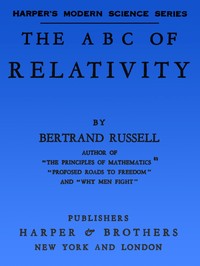
The A B C of Relativity Book Summary
Bertrand Russell's The A B C of Relativity is a classic introduction to the concepts of relativity, aimed at making the complex ideas accessible to a general audience. First published in 1925, the book seeks to explain Einstein's theories of special and general relativity in a clear and understandable manner, without relying heavily on complex mathematics. Russell uses analogies and thought experiments to help readers grasp the fundamental principles of relativity, including the nature of space and time, the speed of light, and the curvature of spacetime.
The book is about simplifying and explaining the theories of relativity developed by Albert Einstein. Russell breaks down complex concepts such as time dilation, length contraction, and the equivalence of mass and energy (E=mc²). He also discusses the philosophical implications of relativity, challenging traditional notions of absolute space and time. The book is structured to build understanding progressively, starting with the basics of motion and moving towards more advanced topics like the curvature of spacetime and the general theory of relativity.
- Relativity of Motion: Russell explains that motion is always relative to a frame of reference. There is no absolute state of rest or motion, and the laws of physics are the same for all observers in uniform motion (special relativity).
- Time Dilation and Length Contraction: Moving clocks run slower compared to those at rest, and moving objects contract in the direction of motion. These effects become significant at speeds approaching the speed of light.
- Spacetime and the Speed of Light: Russell introduces the idea of spacetime as a four-dimensional continuum where time and space are interwoven. The speed of light is constant in all frames of reference, leading to the relativity of simultaneity.
- General Relativity and Gravitation: Gravity is not a force but a curvature of spacetime caused by mass and energy. Objects move along geodesics (the shortest paths) in this curved spacetime, which we perceive as gravitational attraction.
- Mass-Energy Equivalence: The famous equation E=mc² shows that mass can be converted into energy and vice versa, with profound implications for our understanding of the universe.
This book is fit for readers who are curious about the fundamental nature of the universe and are willing to engage with abstract concepts. It is particularly suitable for those with little to no background in physics or mathematics, as Russell avoids complex equations and focuses on conceptual understanding. If you enjoy thought experiments and philosophical discussions about space, time, and reality, this book is a good fit.
Yes, the book still matters today. While some of the scientific details may have been refined since its publication, the core ideas of relativity remain foundational in modern physics. The book's clear and accessible explanations continue to be valuable for anyone seeking to understand the principles of relativity. However, for those looking for a more up-to-date treatment of the subject, a newer book like Relativity: The Special and the General Theory by Albert Einstein or A Brief History of Time by Stephen Hawking might be recommended.
| Reading on Gutenburg | Free reading |
| Get Paperback Version on Amazon | Buy a book |
| Suggest Book : Relativity: The Special and the General Theory Book | Get on Amazon |
The A B C of Relativity by Bertrand Russell remains a timeless introduction to the theories of relativity. Its clear and engaging explanations make complex ideas accessible to a broad audience. While the book was written nearly a century ago, its core messages about the nature of space, time, and gravity are still relevant today. For those interested in delving deeper into the subject, more recent books can provide additional insights and updates to the field.