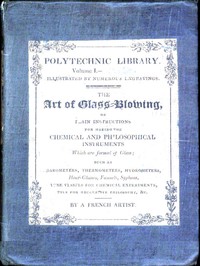
The Art of Glass-Blowing Plain Instruction for the Making of Chemical and Philosophical Instruments Which are Formed of Glass Book Summary
About the Book
'The Art of Glass-Blowing' is a practical guide written primarily for individuals interested in crafting glass instruments for scientific purposes. It emerged during a time when accurate glassware was crucial but often unavailable commercially, making self-sufficiency in glassblowing a valuable skill for scientists, inventors, and educated amateurs. The text focuses on the processes involved in creating specific types of glassware, from simple tubes to complex laboratory retorts and burners.
While the book is titled 'The Art of Glass-Blowing', its emphasis is heavily on the practical application of these skills, specifically tailored to the needs of chemical and philosophical (scientific) investigations. It outlines the necessary tools, furnaces, and techniques, providing a step-by-step approach to fabrication. The author, likely drawing from established craft knowledge and practical experience, presents the information in a methodical, instructional manner, aiming to enable readers to replicate essential scientific equipment themselves.
Key Lessons
The book imparts fundamental knowledge and skills in glassblowing tailored for scientific utility:
Systematic Approach to Fabrication: It breaks down the complex process of glassblowing into discrete, manageable steps. From preparing the glass batch (the raw materials) and melting it in a furnace, to gathering molten glass on the blowpipe, cutting, blowing, shaping, and finally assembling the pieces, the text provides instructions, often specifying the amount and type of glass needed. This methodical breakdown makes the craft less daunting and more reproducible.
Emphasis on Scientific Utility: The instructions are not generic; they are specific to creating instruments required for experiments. This includes details on making burners (devices for heating), condensers, receivers, tubes of different lengths and diameters, and retorts (flask-shaped vessels for distillation). The author explains how the shape and thickness of the glass affect the instrument's function, ensuring the glassware performs adequately for scientific purposes.
Practical Tools and Techniques: While not inventing entirely new methods, the book details the essential tools like the blowpipe, clay pipe, marver (a shaping surface), and various shears. It explains techniques such as 'blowing' (shaping the glass with air), 'cutting' (using a diamond saw or wheel), 'flaring' (opening the end of a tube), and 'fusing' (joining pieces). Clear descriptions and likely accompanying diagrams (though not always preserved perfectly in digital scans) guide the reader through each manipulation.
Material Focus: The book assumes the reader will work with specific types of glass, typically soda glass, explaining how the material behaves when heated and manipulated. Understanding the properties of the glass is integral to successful fabrication, and the text reflects this material-centric approach common in pre-modern glassblowing.
Is This Book Fit For Me?
- If you are interested in the history of science or scientific instrumentation.
- If you are curious about traditional glassblowing techniques and craftsmanship.
- If you are a student or amateur scientist looking to understand the basics of making simple glass lab equipment (though attempting this requires caution).
- If you are a historian, conservator, or someone involved in the replication of historical artifacts.
- If you enjoy detailed, step-by-step instructional texts from the past.
Yes, 'The Art of Glass-Blowing' still matters today, primarily as a historical document and a testament to the practical skills required for scientific advancement.
While modern glassblowing for scientific purposes is often done using specialized laboratory equipment and mass-production techniques, the fundamental principles of working with glass remain relevant. The book offers insight into:
- The evolution of glassblowing knowledge and techniques.
- The challenges faced by early scientists in developing their own tools.
- The deep connection between material science, craftsmanship, and scientific experimentation.
- The importance of precise glassware design for reproducible experiments.
| Reading on Gutenburg | Free reading |
| Get Paperback Version on Amazon | Buy a book |
| Suggest Book : The Family: A World History Book | Get on Amazon |
In conclusion, 'The Art of Glass-Blowing' is a valuable resource for understanding the practical skills and knowledge that underpinned scientific progress in the past. Although its techniques and materials may seem dated, the book remains an important piece for historians, scientists appreciating the craft behind instruments, and anyone interested in the history of technology and the making of scientific tools. It provides a fascinating glimpse into how experimental science was conducted before the advent of sophisticated, commercially produced glassware.