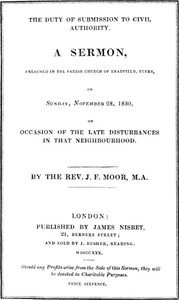
The Duty of Submission to Civil Authority, A Sermon Preached in the Parish Church of Bradfield, Berkes, on Sunday, November 28, 1830, on Occasion of the Late Disturbances Book Summary
The book is a sermon delivered by William Edward Jelf, a clergyman, in 1830, addressing the duty of submission to civil authority. It was preached in response to the disturbances and unrest occurring at the time, particularly the Swing Riots in England. Jelf emphasizes the importance of obedience to the law and the divine right of rulers, drawing from biblical references to support his arguments.
The book is a sermon that explores the Christian duty of submission to civil authority. It discusses the divine origin of government, the responsibilities of rulers and subjects, and the consequences of disobedience. Jelf argues that civil authority is ordained by God and that Christians must obey the law, even if they disagree with it, unless it directly contradicts divine commandments.
- Divine Origin of Government: Jelf emphasizes that civil authority is established by God and that rulers are His ministers. He uses Romans 13:1-2 to argue that resisting authority is equivalent to resisting God's ordinance.
- Responsibility of Rulers: The sermon highlights that rulers are accountable to God for their actions and must govern justly and in accordance with divine principles.
- Duty of Submission: Jelf stresses that subjects must obey the law and respect their rulers, even if they are unjust, unless the law directly conflicts with God's commandments. He cautions against rebellion and anarchy.
- Consequences of Disobedience: The sermon warns that disobedience to civil authority leads to societal chaos and divine punishment. Jelf believes that the disturbances of his time are a result of moral decay and a departure from Christian principles.
- Role of Religion: Jelf argues that Christianity promotes peace and order and that adherence to its teachings can prevent social unrest. He calls for a return to religious values to restore stability.
This book is fit for readers interested in the historical perspective on the relationship between religion and civil authority, particularly during times of social unrest. It is also relevant for those studying the theological justifications for obedience to the law and the role of Christianity in maintaining social order.
Yes, the themes of the book still matter today. The relationship between civil authority and individual rights, the role of religion in public life, and the balance between obedience and resistance are ongoing debates in modern society. Understanding historical perspectives can provide valuable insights into contemporary issues.
| Reading on Gutenburg | Free reading |
| Get Paperback Version on Amazon | Buy a book |
| Suggest Book : The Righteous Mind: Why Good People Are Divided by Politics and Religion by Jonathan Haidt Book | Get on Amazon |
In conclusion, Jelf's sermon provides a historical and theological perspective on the duty of submission to civil authority. While some of his views may seem outdated, the core themes of the book remain relevant in today's discussions about governance, obedience, and the role of religion in society. For readers interested in exploring these themes further, I recommend 'The Righteous Mind: Why Good People Are Divided by Politics and Religion' by Jonathan Haidt, which offers a modern psychological analysis of moral and political divisions.