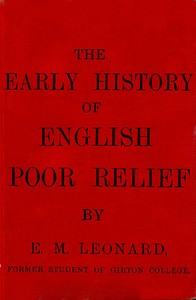
The Early History of English Poor Relief Book Summary
Introduction
This book provides a historical overview of how England dealt with poverty from the Middle Ages through the early 19th century. The author traces the development of poor relief systems, from localized community efforts to the more formalized and centralized approaches that emerged over time. Understanding this history offers valuable insights into the evolution of social welfare systems and the complex interplay between government, religion, and society in addressing poverty.
What is this book about?
'The Early History of English Poor Relief' examines the changing attitudes and institutions concerning poverty in England. It looks at how relief was initially provided through local means, often linked to religious charities and community mutual aid. The book then follows the development towards more systematic, albeit often harsh, state-administered relief systems like the Poor Law Amendment Act of 1834. The narrative spans from roughly the 13th century to the mid-19th century, covering the Black Death, the rise of parish-based relief, and culminating in the significant reforms of the Victorian era.
Key Lessons
The book reveals the deep-rooted religious motivations behind early poor relief, often viewing poverty through a lens of sin and the deserving versus undeserving poor, even in medieval times. For example, monastic hospitals and religious guilds provided care, reflecting a pious concern that gradually evolved.
It demonstrates how economic factors, particularly population changes like the Black Death, fundamentally altered approaches to poverty. The drastic reduction in population led to labor shortages but also entrenched ideas of pauperism and the need for strict controls on the poor.
Furthermore, the book highlights the often contradictory nature of poor relief policies. Systems aimed at providing assistance frequently included severe restrictions and punishments, reflecting societal fears and a desire to control rather than genuinely empower the poor. The harsh conditions in workhouses under later Poor Laws stand as a stark example of this punitive aspect.
Ultimately, it shows a gradual shift from localized, community-based charity towards a more standardized, centralized, and impersonal system of relief administration, driven by growing state involvement and changing economic and social structures.
Is this book fit for me?
If you are interested in the history of social welfare, poverty, or the development of the modern state, this book is highly relevant. You will find value if you want to understand:
- The historical roots of contemporary debates about welfare and poverty.
- The evolution of government responsibility for social problems.
- How attitudes towards the poor have changed over centuries.
- The effectiveness (or lack thereof) of different approaches to managing poverty.
- Early examples of social policy and administration.
Does it still matter today?
Yes, absolutely. Understanding the history of poor relief is crucial because many of the debates surrounding modern welfare systems—such as the balance between state support and individual responsibility, the definition of deserving vs. undeserving poor, and the tension between compassion and fiscal prudence—have echoes in historical arguments. The book provides context for understanding the origins of institutions like the modern welfare state and the challenges inherent in designing effective and humane poverty alleviation programs.
Given its enduring relevance, here is another book that delves into the philosophy behind social welfare systems:
suggest_book
Why this book? 'The Road to Serfdom' by F.A. Hayek offers a critical perspective on the rise of the welfare state and the potential unintended consequences of extensive government intervention in the economy and society, providing a different but complementary angle to understanding modern social policy debates.
| Reading on Gutenburg | Free reading |
| Get Paperback Version on Amazon | Buy a book |
| Suggest Book : The Road to Serfdom Book | Get on Amazon |
Conclusion
'The Early History of English Poor Relief' provides a valuable historical lens through which to view the complex issues of poverty and social support. By tracing the evolution of poor relief from medieval religious charity to Victorian state control, the book illuminates deep-seated societal attitudes, the impact of economic shocks, and the challenges of designing systems to help those in need without unintended negative consequences. It remains a relevant resource for anyone seeking to understand the foundations of modern social welfare systems and the ongoing debates surrounding them.