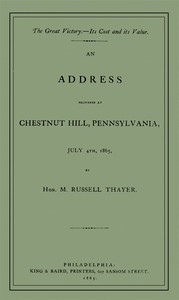
The Great Victory—Its Cost and Its Value Address delivered at Chestnut Hill, Pennsylvania, July 4th, 1865 Book Summary
Delivered on July 4th, 1865, just months after the end of the American Civil War, The Great Victory—Its Cost and Its Value is not a celebratory speech in the traditional sense. Instead, it's a deeply thoughtful and sobering address by James Freeman Clarke, a Unitarian minister, reflecting on the immense sacrifices made to preserve the Union and the moral responsibilities that come with victory. It's a call for humility, justice, and a forward-looking vision for a reunited nation.
This address isn't a recounting of battles or political maneuvering. Clarke focuses on the *meaning* of the Union victory. He argues that the war wasn't simply about preserving a geographical entity, but about upholding fundamental principles of justice, freedom, and self-government. He explores the immense human cost of the war – the lives lost, the families shattered – and insists that this cost demands a commitment to building a truly equitable and just society, particularly for the newly freed slaves. Clarke also warns against the dangers of national arrogance and the temptation to impose the victor's will upon the vanquished, advocating instead for reconciliation and a shared future.
One of the most powerful lessons Clarke conveys is the idea that victory, especially one achieved through such brutal conflict, doesn't automatically equate to righteousness. He stresses that the North, while ultimately on the side of justice in preventing the expansion of slavery, was not without its own flaws and prejudices. The war, he argues, should serve as a constant reminder of the fragility of freedom and the need for continuous self-examination. He uses the analogy of a physician who, after successfully treating a disease, must continue to monitor the patient's health to prevent relapse. Similarly, the nation must remain vigilant against the return of the ideologies that fueled the conflict.
Clarke also emphasizes the crucial importance of extending the benefits of freedom to all, specifically the formerly enslaved population. He doesn't shy away from acknowledging the enormous challenges ahead – the need for education, economic opportunity, and legal protection – but insists that these are moral imperatives, not optional extras. He frames the issue not just as one of charity, but as a matter of fulfilling the promise of the nation's founding principles. He points out that true victory isn't just defeating an enemy, but creating a society where all individuals can flourish and participate fully in the democratic process. Without this, the sacrifice of the war is rendered meaningless.
Furthermore, the speech is a potent warning against the pitfalls of national hubris. Clarke cautions against viewing the victory as a sign of American exceptionalism or a license to dominate others. He argues that true strength lies not in military might or economic power, but in moral integrity and a commitment to universal principles. He draws parallels to historical empires that crumbled due to their own arrogance and internal decay. He suggests that a nation’s character is more important than its conquest, and that a focus on internal improvement and justice is the only path to lasting greatness. The speech is a plea for humility in the face of immense power.
Finally, Clarke underscores the necessity of reconciliation. While acknowledging the deep wounds inflicted by the war, he argues that lasting peace requires a willingness to forgive and rebuild. He doesn't advocate for forgetting the past, but for learning from it and moving forward with a spirit of empathy and understanding. He believes that a shared commitment to the nation's future, based on principles of justice and equality, is the only way to heal the divisions that have torn the country apart. This isn't a call for superficial harmony, but for a genuine effort to bridge the gap between North and South and create a more unified nation.
This address will resonate with readers who:
- Are interested in the aftermath of the Civil War and the challenges of Reconstruction.
- Appreciate thoughtful reflections on the meaning of war and victory.
- Seek a nuanced perspective on American history, acknowledging both its triumphs and its failures.
- Are interested in the intersection of politics, morality, and social justice.
- Enjoy historical speeches and essays.
Absolutely. Clarke’s warnings about national arrogance, the importance of extending freedom to all, and the need for reconciliation remain profoundly relevant in the 21st century. The speech serves as a timeless reminder that military or political victory is incomplete without a corresponding commitment to justice and equality. The issues of racial inequality, political polarization, and the responsible use of power continue to plague societies around the world, making Clarke’s insights as pertinent now as they were in 1865.
To further explore the themes of post-conflict reconciliation and the long-term consequences of war, I recommend reading:
| Reading on Gutenburg | Free reading |
| Get Paperback Version on Amazon | Buy a book |
| Suggest Book : A Bright Shining Lie: John Paul Vann and America in Vietnam Book | Get on Amazon |
The Great Victory—Its Cost and Its Value is a powerful and enduring testament to the complexities of war and the enduring importance of moral principles. It’s a short but deeply impactful read that challenges us to consider not just *how* we win, but *what* we win for, and at what cost. It’s a vital piece of American history that continues to offer valuable lessons for the present and future.