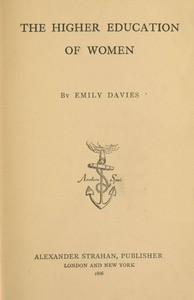
The higher education of women Book Summary
Introduction
Published in 1892, "The Higher Education of Women" by Sarah Stickles Lyman was a progressive work advocating for the intellectual development and societal participation of women through higher education. It emerged during a time when educational opportunities for women were severely restricted, often limited to domestic skills. Lyman argued passionately that women were intellectually capable and that denying them higher education was detrimental not only to the individuals but also to society as a whole.
What is this book about?
Lyman's central thesis is that higher education is essential for the intellectual, moral, and social development of women. She challenges the prevailing societal norms that restricted women's education, arguing that such limitations would create an intellectual underclass and hinder progress. The book details the intellectual capabilities of women, critiques the lack of educational opportunities, and outlines the benefits of educating women for fields beyond the domestic sphere, such as science, literature, and philosophy. She envisioned educated women contributing significantly to society as teachers, leaders, and thoughtful citizens.
Key Lessons
Lyman fundamentally argues that intellectual pursuits are not gender-exclusive. She meticulously counters the common belief that women's minds are unsuited for rigorous academic study, pointing to the intellectual achievements of historical female figures and the logical capabilities observed in everyday life. For example, she emphasizes the importance of cultivating reason and critical thinking in women, skills she believed were essential for navigating complex social issues and contributing meaningfully to public discourse. Furthermore, Lyman champions the idea that higher education empowers women, granting them independence, sharpening their judgment, and enabling them to fulfill broader societal roles beyond marriage and domesticity. She envisioned educated women becoming influential educators, social reformers, and leaders who could improve communities and drive progress. Ultimately, the book serves as a powerful assertion that equality in education is foundational for achieving gender equality and societal advancement.
Is this book fit for me?
This book is ideal for readers interested in the history of women's rights, the evolution of higher education, or the social and intellectual movements of the late 19th century. It is particularly valuable for educators seeking historical context for the push for coeducation and expanded curricula for women. Additionally, individuals researching the history of feminism, gender studies, or the role of women in society will find it insightful. However, due to its age and specific historical context, readers looking for contemporary perspectives on women's education or modern debates surrounding the topic might find it less directly applicable.
Does it still matter today?
Yes, absolutely. While significant progress has been made since 1892 regarding women's access to higher education, the core arguments of "The Higher Education of Women" remain profoundly relevant. Lyman's arguments about the intellectual equality of women and the societal benefits of their education are cornerstones of ongoing discussions about gender parity in academia and the workforce. The book powerfully underscores the idea that education benefits everyone when more people are equipped with critical thinking skills and contribute their talents. It serves as a historical touchstone for understanding the long struggle for educational equality and the continued importance of ensuring diverse perspectives are valued in higher learning institutions.
| Reading on Gutenburg | Free reading |
| Get Paperback Version on Amazon | Buy a book |
| Suggest Book : Pedagogy of the Oppressed Book | Get on Amazon |
Conclusion
"The Higher Education of Women" offers a compelling historical perspective on the fight for women's intellectual rights and societal recognition. While its specific historical context differs vastly from our own, its core message advocating for equal educational opportunities and the empowerment of women through knowledge remains vital. It stands as a testament to the enduring belief that education is a fundamental tool for personal development and societal progress, applicable across different eras and struggles. Reading it provides valuable insight into the past and reinforces the ongoing importance of striving for educational equity. Tags : Gender & Sexuality Studies History - British Teaching & Education