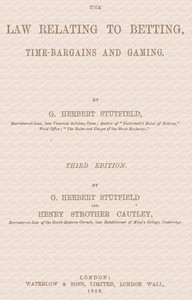
The law relating to betting, time-bargains and gaming Book Summary
Published in 1912, The Law Relating to Betting, Time-bargains and Gaming by George Henry Lees Hall is a surprisingly detailed and comprehensive look at the legal landscape surrounding these activities in England and Wales at the turn of the 20th century. It's a fascinating historical document, offering a window into societal attitudes towards gambling and the attempts to regulate it.
This book meticulously examines the laws governing betting, time-bargains (essentially forward contracts on future events, often related to horse racing), and gaming – encompassing everything from lotteries and prize competitions to the operation of gambling houses. Hall doesn't just state the laws; he delves into the historical context, case law, and interpretations that shaped them. He covers the statutes in force at the time, like the Gaming Act of 1739 and the Street Betting Act of 1853, explaining their provisions and how they were applied (or misapplied) by the courts. The book also explores the nuances of what constituted illegal 'gaming' versus legitimate 'sporting' activities, a surprisingly grey area at the time.
One of the most striking takeaways is the sheer complexity of the legal framework surrounding gambling, even over a century ago. Hall demonstrates how legislation was often reactive, attempting to close loopholes created by clever individuals exploiting ambiguities in the law. For example, the rise of ‘street betting’ – bookmakers openly taking bets on public roads – prompted the Street Betting Act, but even that law had limitations and was frequently circumvented. This highlights a recurring theme in regulation: the constant cat-and-mouse game between lawmakers and those seeking to profit from activities the law aims to control.
The book also reveals the strong moral undercurrents influencing gambling legislation. Gambling was frequently viewed as a vice that preyed on the poor and vulnerable, leading to social unrest and financial ruin. This moral perspective is evident in the harsh penalties prescribed for running illegal gaming houses and the attempts to suppress activities deemed ‘disorderly.’ Hall doesn’t necessarily endorse this view, but he meticulously documents how it shaped the legal landscape. He points out, for instance, how the law often distinguished between ‘gentlemen’s’ gambling (considered more acceptable) and the gambling of the working class.
Furthermore, the book illustrates the importance of precedent in common law systems. Hall spends considerable time dissecting key court cases, showing how judges interpreted the statutes and established legal principles. These precedents then guided future decisions, creating a body of case law that was just as important as the statutes themselves. Understanding these cases is crucial to grasping the full scope of the law at the time. For example, he details cases that clarified the definition of a ‘common gaming house’ and the evidence required to prove its operation.
Finally, the book demonstrates the difficulties in defining and categorizing different forms of gambling. The line between a legitimate ‘time-bargain’ (a contract for the future delivery of goods) and an illegal wager was often blurred, leading to legal disputes. Hall explains how courts attempted to draw this distinction, focusing on whether the contract was genuinely intended to facilitate trade or was simply a disguised bet. This ambiguity underscores the challenges inherent in regulating rapidly evolving forms of financial speculation and gaming.
This book is ideal for:
- Legal historians: It provides a detailed snapshot of gambling law in early 20th-century England.
- Students of law and regulation: It’s a case study in how laws evolve in response to social and economic changes.
- Anyone interested in the history of gambling: It offers insights into the practices and attitudes surrounding betting and gaming during that period.
- Researchers studying Victorian and Edwardian society: Gambling was a significant part of the social fabric, and this book sheds light on its legal and moral context.
While the specific statutes discussed in this book are largely obsolete, the underlying principles and challenges remain remarkably relevant. The tension between regulating gambling to protect vulnerable individuals and allowing freedom of choice, the difficulties in defining what constitutes illegal gambling, and the constant need to adapt laws to new technologies (like the internet) are all issues that continue to be debated today. The book serves as a valuable reminder that gambling regulation is a complex and ongoing process.
Yes, it still matters today. To understand the modern evolution of gambling law, it's helpful to see its roots. Therefore, the next book to read would be:
| Reading on Gutenburg | Free reading |
| Get Paperback Version on Amazon | Buy a book |
| Suggest Book : Gambling Law: Developments and Challenges Book | Get on Amazon |
The Law Relating to Betting, Time-bargains and Gaming is a fascinating, if somewhat dense, historical document. It’s not a light read, but it offers a unique and insightful perspective on the legal and social history of gambling, and its lessons continue to resonate in the modern era. It’s a testament to the enduring challenges of regulating an activity that has always been both a source of entertainment and a potential source of harm.