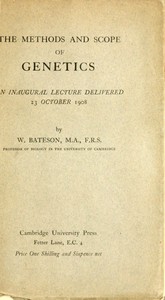
The Methods and Scope of Genetics An inaugural lecture delivered 23 October 1908 Book Summary
The book The Methods and Scope of Genetics is an inaugural lecture delivered by William Bateson on October 23, 1908. It is a foundational text in the field of genetics, presented at a time when the study of heredity was undergoing significant changes and advancements. Bateson, a pioneering geneticist, discusses the methods, scope, and future directions of genetics, emphasizing the importance of experimental breeding and the study of variation and heredity.
This book is about the methods and scope of genetics as a scientific discipline. Bateson explores the history and development of genetics, the importance of experimental breeding, and the study of variation and heredity. He discusses the limitations of previous approaches to the study of heredity and advocates for a more rigorous, experimental method. The lecture is a call to action for the scientific community to embrace the new field of genetics and to apply its methods to a wide range of biological and practical problems.
- Importance of Experimental Breeding: Bateson emphasizes the need for controlled breeding experiments to understand heredity. He argues that such experiments are essential for uncovering the laws that govern the transmission of traits from one generation to the next. For example, he discusses Mendel's work with pea plants, which laid the foundation for modern genetics.
- Study of Variation: Bateson highlights the importance of studying variation within species. He believes that understanding the causes and patterns of variation is crucial for understanding heredity. He suggests that variation is not merely random but can be systematically studied and understood through genetics.
- Limitations of Previous Approaches: Bateson critiques previous approaches to the study of heredity, such as the biometric school, which focused on statistical analysis of traits without considering their underlying genetic basis. He argues that these methods are insufficient for understanding the complexities of heredity and that a more experimental approach is needed.
- Future Directions of Genetics: Bateson envisions a future where genetics is applied to a wide range of fields, including agriculture, medicine, and even sociology. He believes that the principles of genetics can be used to improve crop yields, understand human diseases, and address social issues related to heredity.
This book is fit for readers who are interested in the history and development of genetics as a scientific discipline. It is particularly relevant for those who want to understand the foundational ideas and methods that have shaped the field of genetics. The book is suitable for students, researchers, and anyone with an interest in the science of heredity.
Yes, this book still matters today. The foundational ideas and methods discussed by Bateson continue to be relevant in modern genetics. The principles of experimental breeding and the study of variation and heredity are still central to genetic research. Moreover, Bateson's vision of applying genetics to various fields has become a reality, with genetics playing a crucial role in agriculture, medicine, and other areas.
| Reading on Gutenburg | Free reading |
| Get Paperback Version on Amazon | Buy a book |
| Suggest Book : The Gene: An Intimate History by Siddhartha Mukherjee Book | Get on Amazon |
The Methods and Scope of Genetics by William Bateson is a seminal work that laid the groundwork for the modern study of genetics. Bateson's emphasis on experimental breeding and the study of variation and heredity remains relevant today. The book is a must-read for anyone interested in the history and development of genetics. For those looking to explore more recent advancements in the field, The Gene: An Intimate History by Siddhartha Mukherjee is an excellent recommendation.