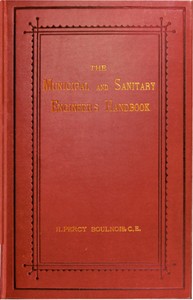
The Municipal and Sanitary Engineer's Handbook Book Summary
Introduction
This summary provides a clear, concise overview of 'The Municipal and Sanitary Engineer's Handbook,' a significant text from the early 20th century. While the book is old, its foundational principles remain relevant to understanding the basics of municipal engineering and public health sanitation.
What is this book about?
'The Municipal and Sanitary Engineer's Handbook' is an early 1900s technical reference aimed at engineers and officials involved in the planning, design, construction, and operation of municipal infrastructure, particularly focusing on sanitation, water supply, and waste management systems. It details the practical knowledge and engineering principles needed to manage water distribution, sewage disposal, drainage, and related public health issues for growing urban populations during a time when these were critical concerns. The book covers calculations, material selection, construction methods, and operational procedures essential for building and maintaining essential public services.
Key Lessons
The book offers a foundational understanding of engineering principles applied to urban public services, emphasizing practical application and the critical link between engineering, public health, and community well-being.
The Interdependence of Sanitation and Public Health: A core lesson is how effectively managing water supply and sewage disposal is not merely an engineering task but a crucial public health measure. The book meticulously details the harmful effects of inadequate sanitation, like cholera and typhoid outbreaks linked to contaminated water or improper waste disposal. It emphasizes that clean water sources and proper removal of sewage are fundamental to preventing disease and ensuring a healthy population. For instance, it explains the need for separate water and sewer systems and the engineering required to maintain them.
Technical Calculations and Design Principles: The handbook provides detailed formulas and methods for calculating flow rates, pipe sizes, reservoir capacities, and other essential parameters for water supply systems and sewerage networks. It breaks down complex engineering concepts into practical steps, making it a valuable resource for those needing to design or manage these systems. Examples include calculating the required diameter of water mains based on flow demand or determining the appropriate slope for gravity sewers.
Materials and Construction Methods: It covers the selection of materials (like cast iron, concrete, brick) for pipes, structures, and other components, discussing their advantages and disadvantages. The book also outlines construction techniques and standards for building robust and durable municipal infrastructure that can withstand environmental and operational stresses.
Operational Considerations and Maintenance: Recognizing that infrastructure needs ongoing care, the book addresses operational aspects like water treatment basics (though chemical methods are less emphasized), pumping station design, and crucially, the importance of regular cleaning, inspection, and maintenance of sewers and waterworks to prevent blockages and failures.
Is this book fit for me?
This book is particularly valuable if:
- You are a student of civil engineering, especially with interests in water resources, environmental engineering, or public health engineering.
- You are researching the history of engineering practice, public health, or urban development in the early 20th century.
- You need a historical perspective on the fundamental principles of water supply and sanitation engineering.
- You are interested in the evolution of engineering standards and practices over time.
- You want to understand the practical calculations and design logic used by engineers before modern software became prevalent.
However, it may be less directly applicable if:
- You are looking for up-to-date codes, regulations, and advanced treatment technologies (like modern membrane filtration or smart water networks).
- You require coverage of newer materials (e.g., plastics) or complex system modeling and optimization techniques.
Does it still matter today?
Absolutely, the fundamental principles and concerns addressed in this book are still highly relevant today. Despite advanced technologies, the core challenges of providing clean water and safe sanitation for growing urban populations remain critical global issues. The book's emphasis on the direct link between engineering infrastructure and public health is as important now as it was in 1910. While the specific materials, calculations, and technologies have evolved significantly, the underlying concepts of hydraulics, material selection, system design, and operational necessity are timeless. It serves as a reminder of how far we've come and the foundational knowledge that led to our modern systems.
| Reading on Gutenburg | Free reading |
| Get Paperback Version on Amazon | Buy a book |
| Suggest Book : A Brief History of Time Book | Get on Amazon |
Conclusion
'The Municipal and Sanitary Engineer's Handbook' is a historically significant work that provides invaluable insight into the practical engineering knowledge and societal concerns of its time. While superseded by modern texts, its core lessons on the importance of water, sanitation, and sound engineering design for public welfare continue to resonate. It offers a fascinating window into the development of municipal infrastructure and remains a useful resource for understanding the enduring fundamentals of this critical field.