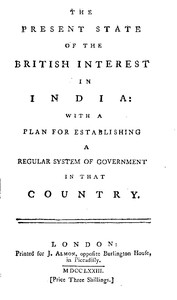
The Present State of the British Interest in India With a Plan for Establishing a Regular System of Government in That Country Book Summary
Smith, a keen observer of the East India Company's operations, meticulously examines the Company's commercial activities, its military campaigns (like the Deccan expedition), and the profound lack of effective governance. He questions the legitimacy of private enterprise wielding such immense power over a vast territory, effectively acting as a quasi-sovereign entity.
The book is divided into two main parts. The first part analyzes the Company's financial state, its trade monopoly, and the immense profits derived from India, implicitly critiquing the nature of mercantilism. The second part focuses on the political and administrative aspects, arguing that the Company, driven by commercial interests, cannot and should not govern a country like India properly. Smith advocates for a complete overhaul, suggesting a 'regular system of government' that would separate administration from commercial interests, ensuring justice, security, and the well-being of the Indian subjects.
1. The Danger of Merging Commercial and Political Power: Smith's central argument is that allowing a private corporation (the EIC) to control both trade and territory leads to inherent conflicts of interest and poor governance. The Company's primary goal was profit, often achieved through war, exploitation, and administrative neglect, which contradicted the need for stable, just rule. Example: The Company's Deccan campaign (1765-67) was heavily criticized by Smith for being driven by excessive speculation and land revenue demands that caused widespread misery, rather than sound strategic or administrative sense.
2. The Need for a Separated, Professional Administrative State: Smith recognized that governing India required expertise and institutions focused solely on administration, justice, and public welfare, free from commercial pressures. He envisioned a well-trained, impartial bureaucracy responsible for law and order, revenue collection (fairly and efficiently), and the protection of subjects, not one answerable to a distant board of directors focused on dividends. This was a radical departure from the ad hoc, profit-driven rule of the Company. Context: This idea anticipated later administrative reforms in the British Empire and influenced ideas about the separation of powers.
3. Moral and Economic Prudence Requires Separation of Concerns: Smith argues that the Company's rule was economically unsustainable and morally questionable in the long run. Its predatory financial practices and disregard for Indian welfare created instability and resentment, undermining the very foundations of its 'interest' in India. He believed that for the Company's own long-term economic security and for the ethical conduct of its affairs, it must separate its commercial functions from its political and administrative responsibilities. This reflected his broader Enlightenment belief that economic prosperity and moral governance are interconnected.
If you are interested in:
- The history of British colonialism and imperialism, especially the early period.
- The development of economic thought, particularly Adam Smith's views beyond Wealth of Nations.
- The intersection of economics, politics, and ethics in historical contexts.
- Understanding the foundations of modern administrative states and the critique of corporate power.
- Early 18th-century political debates and the history of ideas.
Yes, Adam Smith's critique in this book remains profoundly relevant, especially concerning the relationship between corporations, governments, and vast populations.
The core issues he raised—such as the potential for private power to corrupt governance, the need for checks and balances, the ethical responsibilities of economic actors, and the tension between commercial interests and the public good—are timeless. His warnings about the dangers of unchecked corporate influence over political and social systems, while originally directed at the East India Company, resonate strongly in contemporary discussions about modern corporations, lobbying, and the regulation of powerful entities in the digital age or global finance.
Therefore, for readers interested in the enduring themes of this book, a relevant next step would be to explore the concrete implementation and consequences of the ideas Smith critiqued and partially laid the groundwork for.
| Reading on Gutenburg | Free reading |
| Get Paperback Version on Amazon | Buy a book |
| Suggest Book : Company Rule in India Book | Get on Amazon |
Adam Smith's The Present State of the British Interest in India is a foundational text that provides invaluable insight into the origins of British colonial rule and the intellectual currents that shaped economic and political thought. While its specific historical context is unique, Smith's penetrating analysis of corporate power, governance failures, and the moral dimensions of economic activity offers timeless lessons. It serves as a crucial starting point for anyone seeking to understand the complexities of imperialism, the role of private enterprise in state affairs, and the enduring debate over the proper relationship between economics and ethics.