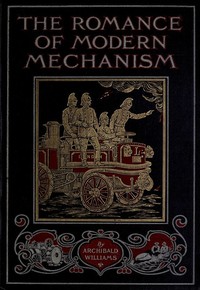
The Romance of Modern Mechanism With Interesting Descriptions in Non-technical Language of Wonderful Machinery and Mechanical Devices and Marvellously Delicate Scientific Instruments Book Summary
Introduction
The world is filled with marvels of engineering and ingenuity, hidden within the gears, levers, and delicate instruments that shape our daily lives. "The Romance of Modern Mechanism" invites readers to explore these fascinating creations, showcasing the ingenuity and imagination that went into designing some of the most remarkable machines ever conceived. This book is not just a technical manual; it's a journey into the heart of how things work, presented in a way that captures the wonder and beauty of mechanical design for anyone who appreciates cleverness and precision.
What is this book about?
Published in 1917, "The Romance of Modern Mechanism" by Arthur F. Layman is a delightful exploration of the principles and wonders of machinery and scientific instruments. Layman, an inventor and engineer, wrote this book to share his passion for mechanical design with a broad audience, not just fellow engineers. The book delves into various mechanisms, explaining their function and purpose in an engaging, narrative style. It covers topics ranging from simple linkages and governors to complex devices like the calculating machines of the era, typewriters, duplicating instruments, and even early phonographs and motion picture projectors. The author uses clear, non-technical language to describe how these machines work, often highlighting the clever solutions engineers devised to overcome challenges. It celebrates the ingenuity and romance inherent in the design and construction of mechanical marvels, making the reader appreciate the hidden logic and beauty in everyday machines.
Key Lessons
The book imparts valuable insights into the principles of mechanics and the history of invention, presented through engaging narratives:
The Logic in Mechanism: Layman demonstrates that machines aren't random collections of parts but are logical extensions of human needs and ingenuity. He breaks down complex devices, showing how basic principles like levers, gears, and cams are combined to achieve specific functions. For example, explaining the mechanism of a simple lock or the governor that keeps a steam engine's speed steady illustrates how fundamental concepts solve practical problems. This teaches readers to look beyond the surface and understand the 'why' behind the 'how'.
The Evolution of Tools: The book highlights how machines evolve to solve problems and improve efficiency. It traces the development of office machines (calculators, typewriters) and precision instruments (duplicators, microscopes), showing how each innovation built upon previous ones. This lesson emphasizes the cumulative nature of technological progress and how understanding past inventions provides context for current technology.
The Art of Design: Layman treats mechanical design not just as an engineering task but as an art form. He appreciates the aesthetic and functional elegance in well-designed mechanisms. Describing the 'graceful motion' of a well-balanced governor or the 'intricate beauty' of a watch mechanism instills an appreciation for the skill and artistry involved in creating functional and beautiful machines.
Celebration of Human Ingenuity: At its core, the book is a celebration of human creativity applied to practical challenges. By detailing the mechanisms behind everyday marvels, Layman inspires a sense of wonder and respect for the inventors and engineers who transformed ideas into tangible tools that shape our world. It encourages readers to see technology not just as something used, but as a product of creative thought and problem-solving.
Is this book fit for me?
If you are someone interested in:
- The history of technology and invention.
- How everyday machines work (without deep technical jargon).
- The intersection of art, logic, and engineering.
- Gaining a new perspective on the tools and devices you use daily.
- Appreciating the ingenuity and problem-solving skills of past engineers.
This book is perfect for you. It offers an engaging and accessible journey into the mechanics of the modern world, presented with a sense of wonder and historical context.
Does it still matter today?
Absolutely. Understanding the fundamental principles and history of mechanisms remains valuable. While the specific devices described by Layman (like the comptometer or early film projectors) are less common today, the core concepts of mechanical advantage, automation, precision, and design principles are more relevant than ever in fields like robotics, computer hardware, automotive engineering, and even user interface design.
Furthermore, the book's approach of demystifying complex systems by breaking them down into understandable parts and celebrating human ingenuity provides timeless thinking tools. It fosters a deeper appreciation for the technology that underpins modern life and inspires a similar sense of wonder about the engineering marvels of the 21st century, from microprocessors to complex manufacturing systems.
| Reading on Gutenburg | Free reading |
| Get Paperback Version on Amazon | Buy a book |
| Suggest Book : The Family: A World History Book | Get on Amazon |
Conclusion
Arthur F. Layman's "The Romance of Modern Mechanism" is a captivating and historically significant piece of writing. It offers a unique glimpse into the machinery and instruments that defined the early 20th century while providing timeless insights into the principles of mechanics and the creative process. Even today, it serves as an engaging primer on how things work and a testament to the enduring appeal of mechanical ingenuity. It stands as a charming celebration of the mechanisms that connect us to the tangible world, encouraging readers to look at technology with fresh eyes and renewed appreciation. Tags : Computers & Technology Engineering & Construction Science - General