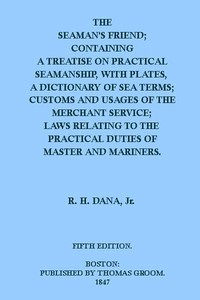
The Seaman's Friend Containing a treatise on practical seamanship, with plates, a dictionary of sea terms, customs and usages of the merchant service Book Summary
Core Seamanship Skills: The book emphasizes practical skills essential for survival and work on a ship. For example, it details various knots for securing cargo or mooring the vessel, explains how to handle ropes safely and effectively, and describes the mechanics of setting sails or operating machinery depending on the vessel. It breaks down complex tasks into step-by-step instructions, focusing on reliability and safety.
Understanding Navigation Basics: It covers fundamental navigation techniques used before modern technology, such as reading maps and charts, using compasses, observing stars (if applicable), and understanding currents and tides. Though outdated for precision, the underlying principles of determining a ship's position and course are still relevant, and the book provides a historical perspective on how sailors navigated the oceans.
Interpreting Weather and Sea Conditions: A significant portion deals with understanding weather signs and sea states. It teaches how to read the sky, wind patterns, and wave behavior to anticipate changes and ensure safety. This practical knowledge of the elements was crucial for survival and efficient operation at sea, and while modern tools provide more data, the ability to read the immediate environment remains valuable.
Terminology and Communication: The dictionary section is vital for understanding the specialized language of the maritime world. Knowing terms like "port," "starboard," "sheets," or "fairlead" is fundamental for clear communication and effective teamwork aboard a ship. This section acts as a crucial reference for anyone entering the field.
Merchant Service Customs: The book outlines the established routines, protocols, and social structures onboard merchant ships during its publication era. Understanding watch schedules, cargo handling procedures, ship's hierarchy, and basic etiquette provides a window into the operational and human aspects of working on a vessel, highlighting the importance of discipline and cooperation.
This book is particularly suitable for:
- Individuals researching or interested in the history of maritime navigation, seamanship, and the merchant marine in the 19th century.
- Students or enthusiasts learning about traditional sailing techniques or rope work, as it provides foundational instructions.
- Those studying historical texts or curious about how sailors communicated and operated before technological advances.
- People involved in maritime museums, reenactments, or educational programs seeking authentic primary source material.
- Anyone needing a historical reference for the specific terminology used in older texts or contexts.
Yes, the core knowledge presented in The Seaman's Friend still holds relevance today, albeit in modified forms:
The fundamental skills of handling lines (ropes) and understanding knots are still taught in maritime training, forming the basis of any seafarer's competence. While specific knots might be standardized today, the principles remain.
Basic navigation principles, though vastly augmented by GPS and other technologies, still underpin modern navigation. Understanding charts, compass use, and environmental factors is still essential knowledge for any navigator.
The ability to interpret weather conditions remains critical for safety and operational planning at sea, even with advanced forecasting tools.
The dictionary aspect is particularly relevant for modern sailors and maritime professionals who encounter archaic terms in historical documents, older regulations, or specialized contexts.
However, the detailed procedures and customs described are largely specific to the technology and practices of the 19th century and may differ significantly from modern regulations and operational standards.
| Reading on Gutenburg | Free reading |
| Get Paperback Version on Amazon | Buy a book |
| Suggest Book : The Art of Navigation: From Sundials to GPS Book | Get on Amazon |
In conclusion, The Seaman's Friend is a valuable piece of historical literature offering practical knowledge, specialized terminology, and insight into 19th-century maritime life. While specific operational details have evolved with technology and regulations, its foundational lessons in seamanship, navigation basics, and the importance of specialized vocabulary remain useful for understanding the craft of sailing and the history of the sea. It serves as an excellent primary source for historical research or for appreciating the practical skills required of past generations of sailors.