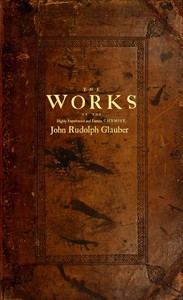
The works of the highly experienced and famous chymist, John Rudolph Glauber Book Summary
Introduction
John Rudolph Glauber was a prominent German chemist (1609-1654) whose work significantly influenced the development of chemistry during the Scientific Revolution. His collected works, compiled posthumously, provide invaluable insights into the chemical knowledge and practices of the mid-17th century. This summary explores the content and significance of his extensive writings.
What is this book about?
The 'Works' of John Rudolph Glauber is not a single monograph but a comprehensive compilation of his various writings, letters, and treatises published after his death. It covers a wide range of topics, primarily focused on practical chemistry, pharmacy, and related industries of his time. Glauber detailed his experiments, discoveries, and theories concerning minerals, salts, acids, alkalis, and their applications in medicine, glassmaking, soap production, and other crafts prevalent during the 17th century. The book reflects the transition from alchemical traditions towards more systematic chemical experimentation and classification.
Key Lessons
Glauber's works emphasize the importance of empirical observation and practical experimentation in understanding the natural world, particularly chemical substances.
Firstly, he advocated for deriving knowledge directly from experiments with materials. For example, his detailed research on sulfur and salt led to the identification and purification of significant compounds like sulfates and sodium carbonate (natron). This wasn't just theoretical; he sought to understand their properties and effects through direct manipulation and testing.
Secondly, Glauber demonstrated the value of systematic classification. He moved beyond vague alchemical descriptions, attempting to categorize substances based on their properties and reactions. His work on salts (salts in the chemical sense of crystalline forms) was particularly influential, detailing their preparation, characteristics, and uses, thereby laying groundwork for modern inorganic chemistry.
Thirdly, the book highlights the crucial role of chemistry in practical arts and medicine. Glauber applied chemical principles to improve glass production, develop cleaning agents like soap, and formulate medicines. He explored the therapeutic properties of various minerals and compounds, reflecting the deep connection between chemistry and medicine in the early modern period.
Finally, his writings often showcase the intellectual curiosity and innovative spirit of the time. He wasn't just recording existing knowledge but actively exploring new avenues, such as the properties of air and the nature of acids and alkalis, building upon the foundations laid by predecessors like Robert Boyle, though his own methods were firmly rooted in direct observation and practical application.
Is this book fit for me?
This collection of Glauber's works is ideal for readers interested in the history of science, particularly the history of chemistry and the Scientific Revolution. If you want to understand the practical chemical knowledge and experimental approaches of the 17th century, this book is essential reading. It provides a direct window into the minds and methods of a leading chemist of his time.
It's also valuable for students of the history of pharmacy, medicine, or technology, as it shows the interplay between chemical discoveries and their applications in healthcare and industry. Furthermore, scholars and enthusiasts of early modern science will find Glauber's detailed accounts of his experiments and the context in which they were conducted extremely useful.
However, readers expecting a modern textbook style or a highly readable contemporary summary might find the language and format challenging, as it's a compilation of 17th-century texts.
Does it still matter today?
Absolutely. Glauber's works remain crucial for historians and scientists alike. They offer fundamental insights into the historical development of chemical concepts, showing how ideas about elements, compounds, acids, and alkalis evolved. His experimental findings, such as detailed descriptions of crystallization and purification techniques for salts, are foundational historical data.
For modern historians of science, understanding the work of figures like Glauber is essential to trace the transition from alchemy to modern chemistry. His emphasis on practical experimentation and classification mirrors the core principles of the scientific method that underpin contemporary science.
Moreover, his work on specific substances like sulfur, natron, and various sulfates provides valuable context for understanding the chemical heritage and the origins of many industrial processes still in use today.
Therefore, **yes, it still matters**. To gain a deeper understanding of the historical context and the practical foundations of modern chemistry, you could read:
suggest_book
| Reading on Gutenburg | Free reading |
| Get Paperback Version on Amazon | Buy a book |
| Suggest Book : Chemistry Made Simple Book | Get on Amazon |
Conclusion
In conclusion, John Rudolf Glauber's collected works are a landmark publication in the history of chemistry. They offer a rich, detailed account of chemical knowledge and practice during a pivotal era. While written centuries ago, they remain essential reading for anyone seeking to understand the roots of modern chemistry, its evolution from alchemy, and the practical roots of chemical science. They are indispensable resources for historians, scientists, and enthusiasts interested in the fascinating journey of chemical understanding.