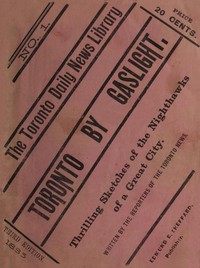
Toronto by Gaslight: The Night Hawks of a Great City As Seen by the Reporters of "The Toronto News" Book Summary
The book provides valuable insights into the social fabric and urban development of 19th-century Toronto:
1. Life Beyond the Formal Day: It demonstrates that cities are alive long after official business hours. The reports show the complex web of activities—social, commercial, and sometimes illicit—that sustained urban life after dark. Taverns weren't just watering holes; they were social hubs, meeting places, and sometimes venues for illicit activities. This highlights the importance of nightlife and informal economies in shaping city identity.
2. Social Stratification Visible at Night: Nighttime often revealed social classes in ways that daytime might not. The reports describe the different establishments catering to various income levels, the presence of transient workers, and the policing of public spaces. It offers a snapshot of class dynamics and the visible inequalities of the era, showing how different groups experienced and utilized the city's night-time offerings.
3. The Role of Journalism in Shaping History: Compiled from newspaper reports, the book exemplifies how contemporary journalism captured the pulse of a growing city. The journalists of the 'Toronto News' provided not just news, but observations and narratives that helped shape public perception and record daily life. It shows the power of the press to document and interpret the world around it, particularly the less formal aspects that official records might overlook.
4. Urban Atmosphere and Atmospherics: The descriptions offered by the reporters are not just factual; they convey the atmosphere and mood of Toronto by gaslight. The quality of gaslight itself, the sounds of the city at night, the character of different neighborhoods after dark, and the overall ambiance are frequently described. This teaches us about the sensory experience of historical urban environments and how details like lighting and location contribute to a city's character.
5. Documentation of Change: By focusing on a specific period (roughly the late 19th to early 20th century), the collection serves as a valuable historical document. It provides firsthand accounts of Toronto's development during this crucial era, offering details about street names, locations, emerging businesses, and social trends that might otherwise be lost, painting a vivid picture of a city in transition.
If you are interested in:
- Toronto's rich history, especially its development in the 19th and early 20th centuries.
- The history of Canadian cities and urbanization.
- Life in Victorian-era North America, focusing on social customs and daily life.
- The role of newspapers and journalism in documenting history.
- The evolution of nightlife and urban culture.
- Unique, anecdotal, and atmospheric historical accounts rather than dry academic texts.
Yes, this book still matters today. It provides a valuable historical baseline for understanding the evolution of Toronto and other North American cities. It offers insights into:
• The long history of urban nightlife, social stratification, and public space management.
• How cities of the past were organized, lived in, and experienced.
• The enduring importance of documenting daily life and informal economies.
It reminds us that the challenges and characteristics of urban life—balancing growth with livability, managing different social groups, understanding the impact of technology (like gas lighting) on daily routines—are not new problems but ones that cities have faced for generations.
| Reading on Gutenburg | Free reading |
| Get Paperback Version on Amazon | Buy a book |
| Suggest Book : The Social Life of Coffee: The Culture and History of a Warm Drink Book | Get on Amazon |