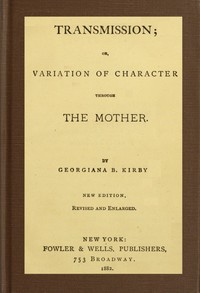
Transmission; or, Variation of Character Through the Mother Book Summary
Transmission; or, Variation of Character Through the Mother, published in 1867 by Horatio Storer, is a fascinating, and at times unsettling, exploration of heredity and the perceived influence of a mother's character on her children. Written during a period of intense scientific curiosity and societal anxieties about degeneration, the book attempts to systematically document and analyze cases of inherited traits – both physical and moral – passed down through the maternal line. It's a product of its time, steeped in Victorian-era beliefs about gender roles and the importance of family lineage, and offers a unique window into the early development of genetic thought.
The book is essentially a case study collection, meticulously compiled by Dr. Storer, a physician, based on interviews and observations of families. He argues that while paternal influence is acknowledged, the maternal transmission of characteristics – including predispositions to disease, mental illness, and even criminal behavior – is significantly underestimated and often more potent. Storer details hundreds of cases, categorizing them by the specific traits allegedly inherited, and attempts to establish patterns and correlations. He's particularly concerned with the inheritance of alcoholism, insanity, and tendencies towards poverty, believing these could be traced back through generations of mothers. The book isn't a theoretical treatise on genetics as we understand it today, but rather a descriptive attempt to demonstrate the reality of what Storer believed was a powerful, often negative, maternal inheritance.
One of the most striking takeaways from Transmission is the pervasive anxiety surrounding degeneration in the 19th century. Storer’s work reflects a deep-seated fear that societal ills – poverty, crime, mental instability – weren’t simply the result of individual failings, but were instead being inherited. This led to a focus on identifying and controlling the breeding of individuals deemed ‘unfit’ to prevent the decline of the population. For example, he meticulously documents families with multiple instances of alcoholism, suggesting that this tendency is passed down through the maternal line, and implicitly raising questions about whether such women should be discouraged from having children. This fear, while rooted in limited scientific understanding, highlights a historical preoccupation with social control and eugenics.
The book also reveals the strong influence of prevailing gender stereotypes on scientific observation. Storer consistently frames the mother as the primary shaper of a child’s character, attributing a disproportionate amount of influence to her emotional state, habits, and even her perceived moral failings. He often contrasts this with a more detached and rational paternal role. This bias is evident in his interpretations of the case studies; for instance, a child exhibiting rebellious behavior is more likely to be attributed to a ‘weak’ or ‘unstable’ mother than to any inherent trait or external influence. It’s a powerful reminder that even scientific inquiry is not immune to the cultural assumptions of its time.
Despite its flaws, Transmission represents an early attempt to understand the principles of heredity. While Storer’s methods are far from rigorous by modern standards, his systematic collection of family histories and his focus on identifying patterns of inheritance foreshadowed the later work of Gregor Mendel and the development of genetics. He recognized that traits could be passed down across generations, even if his understanding of the mechanisms involved was incorrect. His detailed case studies, though often colored by his biases, provide valuable insights into the lived experiences of families grappling with inherited conditions and the social stigma associated with them. He was, in essence, trying to find a logic to patterns that seemed chaotic, a precursor to the statistical approaches used in modern genetics.
This book is ideal for readers interested in:
- The History of Science: It provides a fascinating glimpse into the early stages of genetic thought and the scientific preoccupations of the Victorian era.
- Social History: The book offers insights into 19th-century attitudes towards family, gender, poverty, and mental illness.
- Genealogy and Family History: The detailed case studies, while presented with a specific agenda, demonstrate the importance of tracing family lineages.
- The Darker Side of Scientific Inquiry: It’s a sobering reminder of how scientific ideas can be influenced by social biases and used to justify discriminatory practices.
Yes, Transmission absolutely still matters today, though not as a guide to accurate genetic understanding. Its value lies in its historical context and as a cautionary tale. It demonstrates how easily scientific inquiry can be shaped by pre-existing social prejudices and how dangerous it can be to draw conclusions about individuals or groups based on flawed or biased data. The book’s focus on maternal inheritance, while ultimately incorrect in its specifics, highlights the complexities of genetic transmission and the ongoing debate about the relative contributions of maternal and paternal genes. Understanding the historical roots of eugenic thought, as exemplified by this book, is crucial for preventing its resurgence in modern forms.
To further explore the history of heredity and the ethical implications of genetic research, I recommend reading:
| Reading on Gutenburg | Free reading |
| Get Paperback Version on Amazon | Buy a book |
| Suggest Book : The Gene: An Intimate History Book | Get on Amazon |
Transmission; or, Variation of Character Through the Mother is a challenging but rewarding read. It’s a product of its time, reflecting both the scientific curiosity and the social anxieties of the 19th century. While its conclusions are largely outdated, the book remains a valuable historical document, offering insights into the early development of genetic thought and the dangers of allowing bias to influence scientific inquiry. It serves as a potent reminder that science is not conducted in a vacuum, and that understanding its historical context is essential for evaluating its claims and implications.