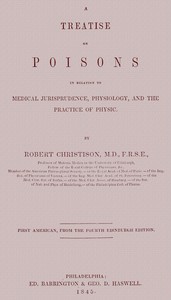
Treatise on Poisons In relation to medical jurisprudence, physiology, and the practice of physic Book Summary
Book's Core Focus
The book systematically catalogues a wide array of poisonous substances, detailing their properties, effects on the human body (physiology), methods of administration, and detection. Its central theme, however, lies in the practical application of this knowledge. It addresses the crucial questions arising from poisonings: How was the poison administered? What were its effects on the body? Who benefited and who suffered? This practical angle directly connects to medical jurisprudence, the intersection of medicine and law, particularly in cases of suspected murder or accidental death. Charsley aimed to provide physicians and legal practitioners with a comprehensive guide to identify poisons, understand their toxicological effects, and thereby contribute to solving crimes and improving medical diagnosis and prevention.Key Concepts and Their Significance
1. Toxicology as an Applied Science: Charsley emphasizes that understanding poisons isn't just academic; it's essential for diagnosing illness, determining causes of death (crucial for criminal investigations), and advising on the safe use of substances. For example, knowing the symptoms of arsenic poisoning helped forensic pathologists distinguish murder from natural causes during Charsley's time.
2. The Interplay of Dose and Toxicity: Building on foundational principles, the treatise explores how the amount and manner of poison administration determine the outcome. It goes beyond simplistic 'a little is good, a lot is bad' to discuss factors like method of entry (ingestion, inhalation, skin absorption) and individual susceptibility, laying groundwork for modern pharmacology and toxicology.
3. Medical Jurisprudence: The Legal Dimension: A significant portion is dedicated to how poison cases are handled legally. Charsley discusses the burden of proof, the role of expert testimony (the physician as witness), and the challenges in proving intent or identifying the poison used. This was groundbreaking, establishing medicine's role in legal contexts like murder trials.
4. Practical Identification and Detection: The book provides practical guidance for physicians on examining vomit, excreta, stomach contents, and other bodily fluids to detect poisons. Procedures described, though rudimentary by today's standards, were cutting-edge methods for the era, such as chemical tests for common poisons like opium or digitalis.
5. Ethical Considerations in Medicine: Implicitly, the treatise touches upon the ethical responsibility of physicians. Charsley discusses the potential for doctors to be implicated in poisonings (e.g., administering questionable remedies) and the importance of careful diagnosis and record-keeping to uphold professional integrity.
Target Audience
- Medical History Enthusiasts: Readers interested in the history of medicine, toxicology, and the development of forensic science will find the detailed descriptions of poisons and their effects historically valuable.
- Students and Researchers in History of Science/Law: The book offers insights into how scientific knowledge intersected with legal systems and public health concerns in the 18th century.
- Medical and Legal Practitioners (for historical context): While not a current reference, it provides foundational understanding of how poisoning cases were historically approached and the evolution of toxicological knowledge.
- Those Studying Early Modern Chemistry: It reflects the state of chemical knowledge and analytical techniques of the period.
- Students of Literature or Social History: The detailed accounts of specific poisons and their societal impact (e.g., use in witchcraft accusations, adultery suspicions) can offer rich material for analysis.
Yes, this treatise remains relevant today, primarily as a historical document and foundational text for understanding the evolution of toxicology, forensic medicine, and medical jurisprudence.
While modern forensic science uses vastly advanced techniques (mass spectrometry, DNA analysis, etc.), the fundamental questions addressed by Charsley – 'What is the poison?', 'How does it affect the body?', 'How was it administered?', 'How can we prove it?' – remain central to criminal investigations and toxicological case work. The book provides a window into the origins of these inquiries and the scientific reasoning applied centuries ago. It helps us appreciate how understanding of poisons and their societal impact has developed over time.
| Reading on Gutenburg | Free reading |
| Get Paperback Version on Amazon | Buy a book |
| Suggest Book : Modern Poison Detection and Forensics Book | Get on Amazon |