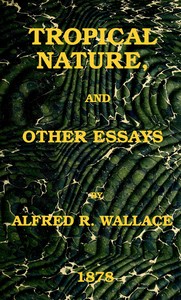
Tropical nature, and other essays Book Summary
Introduction
Henry Walter Bates, a British explorer and naturalist, ventured into the depths of the Amazon rainforest in the mid-19th century. His fascination with the unique and diverse life he encountered led him to write 'Tropical Nature, and Other Essays.' This work is not just a scientific account but also a profound exploration of the intricate workings of nature, the processes of evolution, and the sheer wonder of the tropics. It's a book that invites readers to journey with Bates, not just through the physical landscape, but through his mind as he observes, experiments, and reflects on the natural world.
What is this book about?
'Tropical Nature' is a collection of essays born from Bates' extensive travels and research in the Amazon basin. These essays delve into the unique characteristics of tropical ecosystems, contrasting them with temperate ones. He explores themes like the intense competition among species, the mimicry employed by insects for survival, the distinct patterns of growth and decay in tropical rainforests, and the influence of climate on biological forms. Beyond pure description, the book is fundamentally about his scientific inquiries into evolution, adaptation, and the distribution of life, providing field evidence that was crucial to the development and refinement of Darwin's theories.
Key Lessons
Bates' work offers several enduring insights into the natural world:
1. The Intensity of Tropical Life: The sheer biomass and density of life in the tropics are staggering. Unlike temperate zones with long winters and dormancy, tropical ecosystems offer constant growing conditions year-round. This leads to incredibly high biodiversity, intense competition for resources, and complex food webs. Bates describes the relentless struggle for survival, where even slight advantages can be magnified over generations. He observed countless species coexisting in niches down to the smallest fraction, a testament to the ecological pressure to specialize.
2. Mimicry as a Survival Strategy: Bates is famous for his studies of mimicry. He meticulously documented how various species, particularly insects, imitate each other's appearance. Batesian mimicry occurs when a harmless species mimics the appearance of a harmful one (like a harmless fly resembling a stinger) to avoid predators. Müllerian mimicry happens when two harmful species evolve to look similar (like several different toxic butterflies sharing a warning pattern). These essays reveal mimicry as a sophisticated adaptation honed by intense selective pressures in the tropics, a key example of natural selection in action.
3. Adaptation to Tropical Conditions: Life in the tropics faces specific challenges – intense solar radiation, high rainfall, high humidity, and constant warmth. Bates details adaptations to these conditions. Plants might develop drip-tip leaves to shed water efficiently, or flowers might be scented and colored to attract specific day-active pollinators. Animals might have behavioral adaptations like resting during the hottest part of the day or physiological adaptations to cope with high humidity and constant activity. He contrasts these with adaptations seen in temperate regions, which often involve strategies for coping with seasonal changes and dormancy.
4. Evolution and Natural Selection in Action: Though written before 'The Origin of Species' was formally published, 'Tropical Nature' reflects a deep understanding of evolutionary principles. Bates uses his Amazon observations to provide concrete examples supporting the idea that species evolve and adapt over time through natural selection. He describes geographical variations in species, the process of speciation (new species formation) within the vast Amazon, and how traits like mimicry patterns are likely the result of selective pressures favoring survival and reproduction. His work was instrumental in convincing Darwin and others of the power of natural selection as a driving force of evolution.
Is this book fit for me?
This book is ideal for readers interested in:
- Natural History and Ecology: If you love learning about the specific ways organisms interact and adapt in their environments, particularly in rainforests.
- Evolutionary Biology (Historical Context): While not a modern textbook, it provides fascinating firsthand accounts of early 19th-century scientific exploration supporting evolutionary theory.
- 19th-Century Exploration and Science: Readers fascinated by the history of science, the challenges of exploration, and the correspondence between scientists like Darwin and Bates.
- Engaging Scientific Writing: Those who appreciate detailed, observational, and often lyrical prose that makes complex biological concepts accessible.
- Ecology and Biodiversity: Anyone wanting to understand the unique characteristics of tropical ecosystems and the factors shaping their incredible diversity.
It might be less suitable if you are looking for a purely theoretical discussion of evolution or a contemporary, fast-paced narrative of scientific discovery.
Does it still matter today?
Absolutely. Henry Walter Bates' observations and conclusions from his Amazon expeditions remain profoundly relevant. His detailed descriptions of tropical ecosystems and the adaptations of species within them provide foundational knowledge for modern ecology and conservation biology. His studies of mimicry are still cited as classic examples of natural selection. Furthermore, his work highlighted the immense biodiversity and ecological complexity of tropical rainforests, which are now recognized as critical to global climate regulation and harbor an irreplaceable wealth of life. Understanding the 'why' behind the adaptations and distributions Bates described helps scientists today model current and future impacts of climate change and habitat loss on tropical species and ecosystems.
| Reading on Gutenburg | Free reading |
| Get Paperback Version on Amazon | Buy a book |
| Suggest Book : The Hidden Life of Trees: What They Think, Feel, and Reveal Book | Get on Amazon |
Conclusion
'Tropical Nature, and Other Essays' is more than just a historical document; it's a captivating exploration of life's intricacies in one of Earth's most biodiverse regions. Henry Walter Bates' meticulous observations, blending scientific rigor with a deep sense of wonder, provide timeless insights into adaptation, evolution, and the fundamental workings of ecology. It remains a valuable read for anyone seeking to understand the richness of tropical nature and the enduring power of natural selection. For those drawn to the specific subject of plant life in forests, 'The Hidden Life of Trees' offers a complementary perspective on communication and symbiosis within ecosystems.